Trump said troops would be deployed and join a special task force in the city comprised of various federal agencies, including the FBI, DEA, ICE and the U.S. Marshal’s service
|
|
||
|
Scientists created the most accurate three-dimensional map of star-formation regions in our Milky Way galaxy, based on data from the European Space Agency’s Gaia space telescope. This map will teach us more about these obscure cloudy areas, and the hot young stars that shape them.
Edgewater Officer David Jewell was purchasing a hot dog at a gas station when an employee left the building, re-entered with a gun and repeatedly shot Jewell from behind
Different parts of Mars have different advantages and disadvantages when it comes to their available resources, just like Earth. The polar caps are likely the most valuable in terms of their water content, which will be critical to any early stage crewed mission to the red planet.
Deep in space, an ancient brown dwarf nicknamed “The Accident” has revealed the first-ever detection of a molecule that scientists have been searching for in planetary atmospheres for decades.
Over 200 underwater bridge tunnels exist for vehicular traffic around the world, providing connectivity between cities. Once constructed, however, these tunnels are difficult to monitor and maintain, often requiring shutdowns or invasive methods that pose structural risks.
The period known as “cosmic noon,” which took place roughly 2 to 3 billion years after the Big Bang, was characterized by the rapid formation of new stars and planetary systems. Naturally, objects dated to this period are coveted by scientists hoping to learn more about the processes that led to the formation of planets and the emergence of life itself.
The Event Horizon Telescope (EHT) collaboration, with a substantial contribution from the Max Planck Institute for Radio Astronomy (MPIfR), has unveiled new, detailed images of the supermassive black hole at the center of the galaxy M87. These reveal a dynamic environment with changing polarization patterns near the black hole. For the first time in EHT data, scientists have also detected signatures of extended jet emission near the jet base, where it connects to the ring around the black hole.
The bottom of the world is front and center for a partial solar eclipse next week.
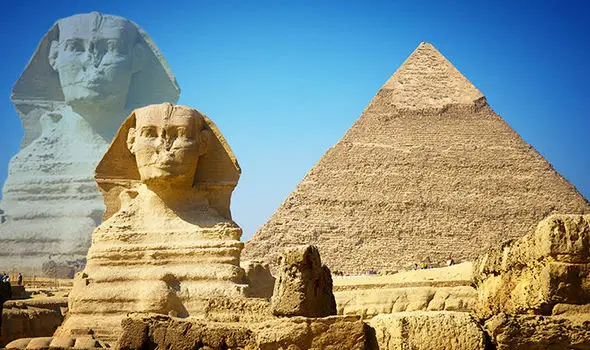
The historians and authors of a ‘controversial’ forthcoming book firmly believe there is a strong possibility a second ‘Great Sphinx’ remains buried at the Giza plateau and suggest the Great Pyramid at Giza were built thousands of years earlier than previously thought, and not by the ancient Egyptians. Two historians have questioned whether the ancient Egyptians built the great pyramid of Giza or the pyramids of Giza for that matter. Instead, the two researchers say, these monuments could have been built by a lost civilization that existed on Earth which we are yet to identify. The authors of an upcoming book that investigates the only remaining wonder of the ancient world cast doubt on the conventional thinking that it was the ancient Egyptians who built the pyramids at Giza in about 2,500 BC. In fact, this isn’t the first time authors have questioned the idea that the ancient Pyramids built these massive structures. The two historians Gerry Cannon and Malcolm Hutton affirm that the great Sphinx of Giza, positioned in front of the pyramids must have been carved from a natural rock long before any sand covered the area, which means that at that time, long ago the area had to be fertile.
In an interview with Express.uk Mr.Cannon said: “The Sphinx must have been carved when there was no sand there. You can not carve a rock when it is under the sand. ” “When it was not under sand was about 12,000 years ago and the Egyptians weren’t there.” This would mean, according to the research of experts, that the pyramids and the Sphinx were built at least 12,500 years ago and could have been standing there before the beginning of the Ice Age. The significant time difference would mean that the massive ‘tombs’ were not built by the ancient Egyptians, according to Mr. Cannon. The historian, though not completely convinced, believes these massive structures may have been built long ago by an advanced ancient civilization that existed somewhere in the region—perhaps Atlantis—which was eventually consumed by the great flood. Mr. Cannon said: “I have done some research and there is a direct line from the pyramids to a submerged continent with a mountain in the sea and on the mountain of the sea, there are two pinnacles that resemble the pyramids. It may be Atlantis, when Atlantis sank they went to another place, probably Egypt and they had the technology to build those pyramids. There is no one else who could have done it, they did not have the technology.” https://www.youtube.com/watch?v=5_R2fb0Wgkw No one knows who or what was there 12,000 years ago. The three smaller pyramids in Giza were probably built by the Egyptians as they could be built by man. However, it is impossible for the three largest pyramids—that have 2,250,000 blocks in them and some blocks weigh up to 250 tons—to have been built by the Egyptians. We could not even move it with all the equipment we have today, so they had to have been made by a civilization that was more advanced than we are today. The words of Mr. Cannon and others who have raised doubts about the Egyptians and the construction of the pyramids have come across a brick wall by the Egyptian authorities who maintain the ancient Egyptians as the actual builders of the pyramids. Second SphinxIn addition to the idea that the pyramids were not constructed by the ancient Egyptians, the authors argue there is a great chance there was s SECOND Sphinx at the Giza plateau. New Curtin University research has uncovered a striking link between the structure of our galaxy and the evolution of Earth’s crust, showing its development was shaped by the impact of meteorites during its journey through the Milky Way and not solely through internal processes as was previously widely considered.
Quantum computing promises to solve the seemingly unsolvable in fields such as physics, medicine, cryptography and more.
Using the James Webb Space Telescope (JWST), astronomers have detected what appears to be a faint and small star-forming complex. The discovery of the new complex, which received the designation LAP2, is detailed in a research paper published Sept. 8 on the arXiv preprint server.
An international team led by the University of Geneva (UNIGE), including scientists from the National Center of Competence in Research PlanetS, the University of Warwick, and the Canary Islands Institute of Astrophysics, has launched an ambitious program to map exoplanets located around the Neptunian Desert. The goal: to better understand the formation and evolution of planetary systems.
If you think a galaxy is big, compare it to the size of the universe: it’s just a tiny dot which, together with a huge number of other tiny dots, forms clusters that aggregate into superclusters, which in turn weave into filaments threaded with voids—an immense 3D skeleton of our universe.
|
||
|
Copyright © 2026 Paranormal News Network - All Rights Reserved Powered by WordPress & Atahualpa 96 queries. 0.125 seconds. |
||