Researchers have developed a new type of microscope that can acquire extremely large, high-resolution pictures of non-flat objects in a single snapshot. This innovation could speed up research and medical diagnostics or be useful in quality inspection applications.
|
|
||
|
Researchers from Japan have discovered a unique Hall effect resulting from deflection of electrons due to “in-plane magnetization” of ferromagnetic oxide films (SrRuO3). Arising from the spontaneous coupling of spin-orbit magnetization within SrRuO3 films, the effect overturns the century-old assumption that only out-of-plane magnetization can trigger the Hall effect.
A massive, mysterious Hole has just opened up on the surface of Antarctica leaving experts confused as they are unable to explain what caused its formation. The hole—as large as lake superior or the state of Maine, with an approximate area of 30,000 square mile—has created confusion among experts, who are unable to explain as to why exactly its there. Some blame it on climate change, but the truth is scientists have no idea. According to atmospheric physicist Kent Moore, a professor at the University of Toronto’s Mississauga campus in an interview with Motherboard: the gigantic, mysterious hole “is quite remarkable, it looks like you just punched a hole in the ice.” This is not the first time massive holes have appeared on Antarctica.  The mysterious apeparence—referrede to as a polynya—is off for a number of reasons but mostly because of its behavior. It was spotted for the first time in the 1970’s but disappeared for several decades before showing up again, causing confusion among scientists. “At that time, the scientific community had just launched the first satellites that provided images of the sea-ice cover from space,” Dr. Torge Martin of the GEOMAR Research Division explains of its initial discovery many decades ago. “On-site measurements in the Southern Ocean still require enormous efforts, so they are quite limited.” The massive hole was recently found by a group of researchers from the University of Toronto and the Southern Ocean Carbon and Climate Observations and Modeling (SOCCOM) project, as they were monitoring the area with satellite technology after a similar hole appeared on Antarctica last years. 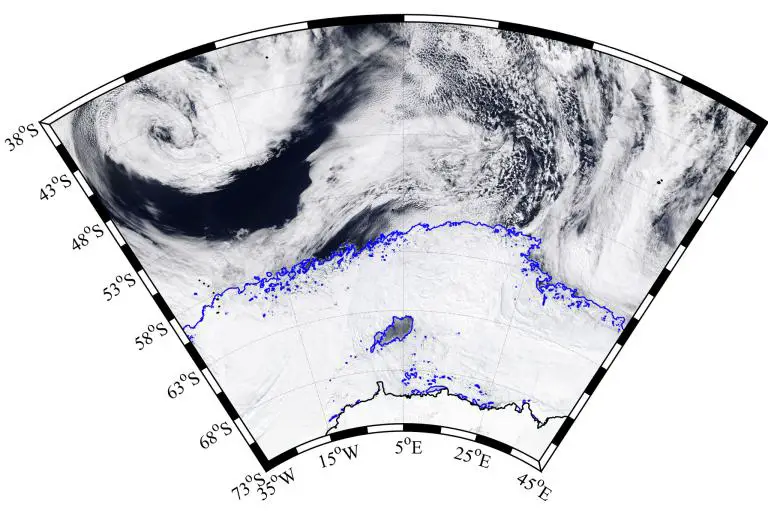 The 2017 hole is the largest one ever detected, having a diameter of around 30,000 square miles. “In the depths of winter, for more than a month, we’ve had this area of open water,” says Kent Moore, professor of physics at the University of Toronto. “It’s just remarkable that this polynya went away for 40 years and then came back.” There are many who are blaming the appearance of the massive holes on climate change, which is one of the main culprits for many abrupt changes seen on the Antarctica continent in the last couple of years. However, scientists are yet to find a connection between climate change and the appearance of massive holes. Researchers from the SOCOM project are conducting a study of the massive hole which will hopefully provide more answers than questions. (H/T Motherboard) Using the MeerKAT radio telescope, an international team of astronomers has performed observations of a galaxy cluster designated SPT-CLJ2337−5942. The observational campaign revealed the presence of an ultra-steep spectrum radio halo in this cluster. The finding is presented in a paper published Sept. 9 on the arXiv preprint server.
Quantum computing, an approach to deriving information that leverages quantum mechanical effects, relies on qubits, quantum units of information that can exist in superpositions of states. To effectively perform quantum computing, engineers and physicists need to be able to measure the state of qubits efficiently.
The Gemini Program was the second manned space program of the United States, developed in the early 1960s during the space race with the Soviet Union. The project began in 1965 after the US space agency finalized its first space flight program: the groundbreaking Mercury project, which had successfully put the first US astronauts into orbit. The Gemini program, unlike its predecessor and its subsequent continuation with the Apollo Program, did not produce as much euphoria in the public opinion although the developments reached in the project would be of vital importance for the development of the future Apollo missions and the goal landing mankind on the surface of the moon. The main purpose of the Gemini program was to demonstrate the possibilities of space flight and coupling that would be used later during the Apollo missions when the lunar module separated from the command module in orbit around the Moon and later meet with the spaceship again after that the astronauts had left the lunar surface. Another goal of the Gemini missions was to extend the astronauts’ stay in space for up to two weeks. This was even more than what was required for the Apollo missions. As you can see, the Gemini project was of great importance as it helped mankind reach the moon, land on its surface and return safely back home. The Gemini 10 Alien encounter
One of the most curious images snapped during the Gemini project was taken in 1966, during the Gemini X mission. Gemini 10 was a manned space mission of the Gemini program made in 1966. It was the eighth manned flight of the Gemini program and the sixteenth of the American space program. The mission lasted for 2 days, 22 hours, 46 minutes, 39 seconds. During Gemini X, astronauts on board snapped a series of images that would later be tucked away in NASA’s archives. One of the images shows a mysterious light to the right of the spacecraft, and planet Earth, unlike anything other in its vicinity. The image can be seen by visiting the following link: http://tothemoon.ser.asu.edu/data_g/G10/Maurer/full/S66-45774_G10-M_f.png
UFO hunters are convinced that what popped up in the image snapped by Gemini mission astronauts was in fact an Alien spaceship, clearly distinguishable by three ‘large’ lights. Upon zooming in, we clearly see what appear to be three bright lights which UFO hunters say are the propulsion system of the alleged alien spacecraft. Curiously, Major Gordon Cooper, astronaut and member of the Gemini Project, testifying under oath to the United Nations said: “I believe that these extra-terrestrial vehicles and their crews are visiting this planet from other planets… Most astronauts were reluctant to discuss UFOs.” He also said: “I’ve been asked about UFOs and I’ve said publicly I thought they were somebody else, some other civilization.”  In 1965, Cooper commanded the Gemini 5. This mission was intended to verify that astronauts could survive in space for 8 days, the time needed to reach the Moon. So there you have it, another extremely interesting image from space showing what many claim to be an otherworldly spacecraft, piloted by advanced beings, not from Earth. Suspect in Charlie Kirk killing is charged with murder as prosecutor says DNA found on rifle triggerThe aggravated murder charge means 22-year-old Tyler Robinson could face the death penalty if convicted of killing Kirk
NASA’s Nancy Grace Roman Space Telescope will help scientists better understand our Milky Way galaxy’s less sparkly components—gas and dust strewn between stars, known as the interstellar medium.
Scientists at NYU Abu Dhabi (NYUAD) have developed an artificial intelligence (AI) model that can forecast solar wind speeds up to four days in advance, significantly more accurately than current methods. The study is published in The Astrophysical Journal Supplement Series.
Caltech scientists have developed an artificial intelligence (AI)–based method that dramatically speeds up calculations of the quantum interactions that take place in materials. In new work, the group focuses on interactions among atomic vibrations, or phonons—interactions that govern a wide range of material properties, including heat transport, thermal expansion, and phase transitions. The new machine learning approach could be extended to compute all quantum interactions, potentially enabling encyclopedic knowledge about how particles and excitations behave in materials.
Westerlund 1, the biggest and closest “super” star cluster to Earth, dazzles in this image released on July 23, 2025. This view combines X-ray data from NASA’s Chandra X-ray Observatory (in pink, blue, purple, and orange), infrared data from NASA’s James Webb Space Telescope (in yellow, gold, and blue), and optical data from NASA’s Hubble Space Telescope (in cyan, gray, and light yellow).
Science is a story of coming up with theories then doing our best to disprove them. That is especially true for theories on a grand, cosmological scale, though disproving them can be particularly hard.
When Rutgers theoretical astrophysicist Charles Keeton first saw an unusual picture shared by his colleague, he was intrigued.
An independent review says incident command wasn’t formally established until 25 minutes after the shooter was in custody and fire crews were dispatched late
|
||
|
Copyright © 2026 Paranormal News Network - All Rights Reserved Powered by WordPress & Atahualpa 102 queries. 0.119 seconds. |
||

