This NASA/ESA Hubble Space Telescope image features the spiral galaxy NGC 4535, which is situated about 50 million light-years away in the constellation Virgo (the Maiden). Through a small telescope, this galaxy appears extremely faint, giving it the nickname “Lost Galaxy.”
|
|
||
|
Light from the half a million satellites that humanity is planning to launch into Earth’s orbit in the coming years could contaminate almost all the images taken by space telescopes, NASA astronomers warned Wednesday.
Galaxies like our Milky Way grew through cascading mergers of smaller galaxies that began billions of years ago. The ancient progenitors of galaxies like ours were small galaxies similar to modern-day dwarf galaxies like the Large and Small Magellanic Clouds. Research shows that both dwarf galaxies and ancient galaxies are less massive, have lower metallicity, and have lots of star-forming gas but relatively few stars. Astronomers try to understand ancient galaxies and how they grew to become so massive by studying dwarf galaxies that are interacting with each other and beginning to merge.
Surprisingly, some of the universe’s brightest objects are black holes. As scorching gas and dust flow around and into a black hole, they glow with fierce intensity across the light spectrum. Now, a team of computational astrophysicists has developed the most comprehensive simulations ever made of how black holes create these dazzling light shows.
Southwest Research Institute (SwRI) scientists believe they may have resolved a 39-year-old mystery about the radiation belts around Uranus.
Scientists have taken a major step toward solving a long-standing mystery in particle physics, by finding no sign of the particle many hoped would explain it.
SUNY Poly Professor of Physics Dr. Amir Fariborz recently published a paper in Physical Review D titled “Spinless glueballs in generalized linear sigma model.” The work takes on a central challenge in modern physics: understanding how the strongest force in nature shapes the inner structure of matter, and how it may produce an unusual form of matter made entirely from the carriers of that force.
The suspect, who immediately met Port St. Lucie officers with gunfire upon their arrival, was shot and killed by return fire as he tried to shoot officers taking cover behind a cruiser
Former Antioch Officer Devon Wenger was convicted in one case of distributing steroids to colleagues and obstruction of justice; he was also found guilty of conspiring against rights
A prototype device that has demonstrated record-breaking longevity could help open up new frontiers in next-generation communications and computing technologies.
Neutrinos, though nearly invisible, are among the most numerous matter particles in the universe. The Standard Model recognizes three types, but the discovery of neutrino oscillations revealed they have mass and can change identity while propagating.
Why does lead behave so differently from every other atomic nucleus when struck by electrons? A team of physicists at Johannes Gutenberg University Mainz (JGU) has taken an important step toward answering this question, only to find that the mystery is even deeper than previously thought. The findings were published in the journal Physical Review Letters.
Most of us first hear about the irrational number π (pi)—rounded off as 3.14, with an infinite number of decimal digits—in school, where we learn about its use in the context of a circle. More recently, scientists have developed supercomputers that can estimate up to trillions of its digits.
A new type of sensor that levitates dozens of glass microparticles could revolutionize the accuracy and efficiency of sensing, laying the foundation for better autonomous vehicles, navigation and even the detection of dark matter.
YouTube Video Here: https://www.youtube.com/embed/LHyg4pcaPN8?feature=oembed&enablejsapi=1 All around the world we find massive stones—weighing more than 1,000 tons—that have been transported, somehow, by ancient civilizations in the past. Without the use of modern technologies, our ancestors achieved the unimaginable, moving massive stones that weigh more than one thousand tons. So, how did they do it? Was it pure manpower? Or is it possible, as some authors suggest, that our ancestors used lost technologies to achieve these incredible feats? If we take a look at a number of ancient sites, we will see that our ancestors managed to build incredible temples using stones that range in weight from a few tons, to a few hundred tons and more. Common sense seems to dictate that these stones were simply too heavy to move for people who did not possess technologies such as the wheel, the pulley, and who did not have the necessary facilities to transport these stones across large distances, so thinking about slave labor and transportation doesn’t really seem to explain all of these achievements. The Ramesseum  In Egypt, we find a number of incredible ancient sites. The Ramesseum is arguably one of the most fascinating. Today, only fragments of the base on torso remain of the majestic statue. Experts have calculated that the Ramesseum had an approximate weight of 1,000 tons. More incredibly, the massive boulder is thought to have been transported more than 200 kilometers away, from Aswan to its resting place in Thebes. It is considered one of the largest stones ever transported by man. How the ancient Egyptians did it remains a profound mystery. The Colossi of Memnon 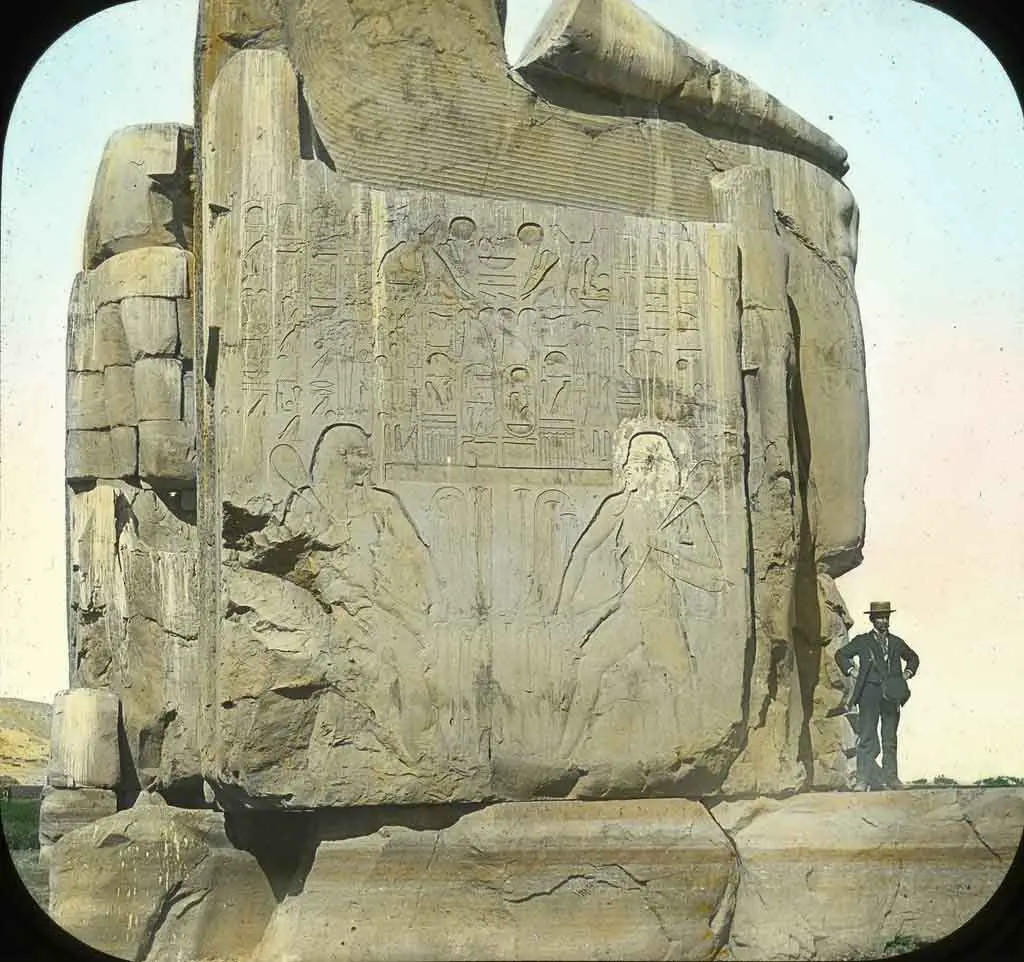 In Egypt, we find another incredible achievement. The Colossi of Memnon are two supermassive statues that were allegedly carved from a single piece of stone each. The statues have been oriented towards the winter solstice. According to R.T. Gould, in his work “A Book of Marvels,” he estimated that the statues had a total weight of 1,200 tons. Incredible, the statues were somehow transported more than 600 kilometers away, over land, without using the Nile River to Thebes. The Foundation stones at Baalbek
Another incredible ancient site—one of my personal favoirtes—is located in Lebanon. At the ancient site of Baalbek, at the Temple of Jupiter, we find the so-called Trilithon, a group of three stones measuring around 19 meters long, 4 metes high, and nearly 4 meters wide. The stones are believed to have been hewn from crystalline limestones. Before the transportation, to their resting place, the stones are believed to have ranged in weight from 1,000 to 1,200 tons. They were somehow transported one kilometer. The stones were later redressed to smaller dimensions so they could accurately fit the wall of the temple. It remains a profound mystery as to how these stones were transported in ancient times. The Western Stone The Western Stone, a massive block forming the lower level of the Western Wall in Jerusalem is another supermassive boulder placed in ancient times. It is considered one of the largest building blocks on the surface of the planet, with an estimated weight of 570 tons. The Great Stele, King Ezana’s Stele, and the Obelisk of Axum  In Ethiopia, we find more evidence of megalithic madness. The Great Stele, King Ezana’s Stele, and the Obelisk of Axum respectively weigh 520 tons, 170 tons, and 160 tons. The stelae were moved from their original quarry some 4 kilometers away. It remains a profound enigma how this was achieved. |
||
|
Copyright © 2026 Paranormal News Network - All Rights Reserved Powered by WordPress & Atahualpa 100 queries. 0.170 seconds. |
||
