The suspect barricaded himself for hours after fatally wounding Vivian Police Officer Marc Brock
|
|
||
|
Sprawled across the Australian continent lies a network of invisible pathways known to the aborigine as ‘Footprints of the Ancestors’. In the West, we know them as ‘Song Lines’ and ‘Dream-Tracks’. They were part of the aboriginal creation myth which spoke of legendary beings who wandered the earth, singing out the name of everything that crossed their path – birds, animals, plants, rocks, waterholes – and so singing the world into existence. Each tribe had their own songline, passed down to them by their ancestors. It was their responsibility to preserve these sacred chants and follow the laws and traditions contained within. They had a duty to protect their songlines, for an unsung territory eventually became a wasteland. If the songs were forgotten, the land itself would wither and die. By singing a landmarks creation song, the country would come to life and flourish with health and vigor. A songline also acts as a map and compass. Providing an aboriginal person knew the song, they could always find their way across the country. A man on a “Walkabout” will always travel down one of their Songlines. If he were to stray from his dream-track, he would be trespassing on somebody else’s land. As long as he stuck to the track, he’d always find people who shared his Dreaming, from whom he could expect hospitality. In theory, the whole of Australia could be read as a musical score (known as a song map). There is hardly a rock or creek in the country that cannot be sung. You can visualize Songlines as a labyrinth of epic stories, turning this way and that, in which every sacred site can be read in terms of its geology, function, and legends associated with it.
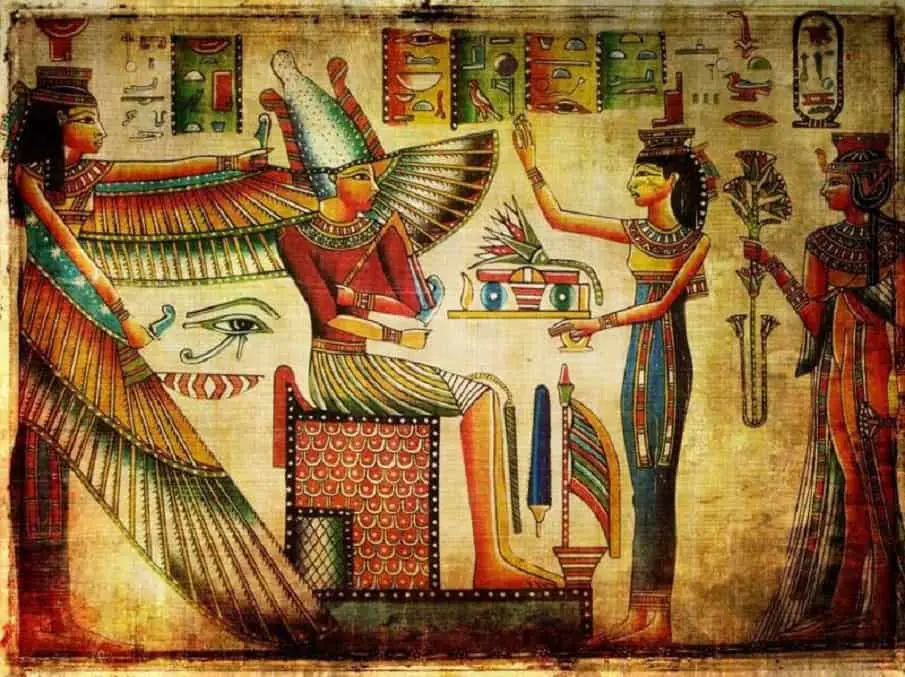
This article was written by Simon E. Davies. Contributor at Ancient-Code.com The Egyptian cosmos is separated into two parts. The upper region consists of the earth (Geb), atmosphere (Shu) and heavens (Nut). Nut and Geb are lovers, but Shu must hold them apart to allow the other gods the freedom to move across the cosmos. Most important of these celestial children is Ra, the sun-god, who sails across the sky at day and into the underworld at night. Whereas the heavenly bodies represent the divine order of the universe, the underworld epitomizes pure chaos. The ‘Duat’, as it is known, is a dark abyss thriving with snakes, monsters and evil spirits.
To bring order to this chaos, several gods made their home in the underworld, helping to guide the dead through its treacherous terrain. It is Ra, the sun-god, who helps bring balance to the cosmos, with the help of his fellow deities. He sails across the ‘River of the Sky’ in the day, resting in his boat known as Mandjet (the day barge). During the evening, he enters the underworld, and the boat would take on the name, Mesketet (the boat of millions). As he descends into the netherworld, the body of Ra perishes, bringing darkness to the upper region of the Earth. A crew of lesser deities guard his body and steer the boat through the perilous underworld, in the hope of bringing him back to life. The boats first stop is at the gap of Abydos, where the souls of countless humans board. They will be judged by Osiris who will determine their place in the afterlife. The Mesketet then sets off on its journey into the underworld, where it will pass through twelve gates, each chamber offering a challenge which must be overcome before Ra can rise again. HOUR 1: At the ‘Watercourse of Ra’, Wepwawet, the opener of ways, unlocks the first gate, allowing the Ra access to the underworld. The boat passes six snakes whom the goddess Ba holds at bay. HOUR 2: It is at ‘Ur Nes’, where Ra’s light nurtures the spirit of the corn so that it may flourish in the upper world, bringing health and abundance to his people. HOUR 3: In the ‘Kingdom of Osiris’, the hearts of mortals are judged against the weight of a feather. If the weight of their sins causes the scales to drop all the way to the bottom, they are eaten by Amemt, devourer of souls. HOUR 4: ‘Living One of Forms’ is a gloomy desert realm, presided over by Sokar, lord of the mysterious. The boat floats quietly over the sands, so as not to rouse a hydra which guards the realm. HOUR 5: The boat of Ra passes into a ravine known as ‘The Hidden’. The way out is guarded by two sphinxes, whose riddles must be solved before the boat can move on. It is Sokar, god of the dead, who helps them solve the guardian’s secrets. HOUR 6: At ‘the Abyss of Waters’, the boat drops into a great river. A monstrous lion prowls its banks, and further along they are joined by Khepera, god of resurrection, who later, will help to revive the body of Ra. HOUR 7: ‘The Secret Cavern’ is a perilous realm, for Apep, lord of Chaos resides there. The great serpent tries to swallow the boat, but Isis, goddess of magic, uses her powers to banish the beast back into the abyss. HOUR 8: ‘Sarcophagus of the Gods’ is the resting place of bygone deities. When the boat of Ra passes, they cry out and salute the sun-god, for his time to arise is close at hand. HOUR 9: As the boat enters the ‘Procession of Images’, the river becomes savage and unruly. The 12-star gods help guide the boat away from fire-breathing serpents, back to safer shores. HOUR 10: The boat now arrives at ‘Lofty of Banks’. A group of Divine warriors protects Ra as a great hawk, known as the ‘Leader of Heaven’, guides them toward the light. Khepera joins himself to Ra, in readiness for his resurrection. HOUR 11: ‘Mouth of the Cavern’ is a land of life and death. Those mortals who were deemed evil in the third hour are cast into a pit, guarded over by goddesses of fire until they perish. Shedu, as a winged serpent, brings with him the promise of a new day. HOUR 12: ‘The Birth Shines Forth’ is the final chamber, where Khepera resurrects the great king Ra. His waking form glides through the mouth of the great serpent known as ‘Life of the Gods’. So it is that Ra is reborn, and the glory of the morning sun causes all people to cheer as his light returns to the upper region of Egypt. Three Osage County deputies and a Kansas Highway Patrol trooper were wounded in the shooting; the 22-year-old suspect was killed at the scene
The trooper’s actions at Kyle Field during the Texas A&M Aggies vs. South Carolina Gamecocks game are under review by the Office of Inspector General
K-9 Igo “made short work of the fleeing suspect,” taking him down and allowing deputies to handcuff the suspect, Thurston County Sheriff Derek Sanders said
The Great Pyramid of Giza is one of the most photographed ancient monuments on the surface of the planet. This majestic structure, located just outside of Cairo, rightfully holds the title as an ancient wonder of the world. We all have seen countless images from the Great Pyramid of Giza, beautiful images that have been snapped by professionals, from the air, the ground using different cameras with countless add-ons, and all of these images have been breathtaking. But what about images from atop the great pyramid? Well, a group of vagabond Russian photographers managed that, and no, it’s not legal so you cant just climb atop the pyramid. Climbing to the top of the Pyramid is an act that can get you locked up for three years in a nasty Egyptian prison, so if you thought on visiting Egypt and climbing up there, don’t. The team of photographers hid from the guards for hours and waited until most of the guards had gone home for the night, then they actually climbed the pyramid and took breathtaking images atop the pyramid, something that only a few can brag about. Having said that it is extremely dangerous and really illegal to climb the pyramid(s), here are incredible images that you probably have never seen before.
Twenty probationary troopers, all of whom just successfully completed field training, received the first of the agency’s new-look Durangos.
“But it’s still not every day that rush hour traffic is being blocked by four horses running down our main thoroughfare,” North Ridgeville Police Capt. Greg Petek
The Land of the Pharaohs as I like to call Egypt is filled with incredible tales. Spanning back thousands of years, the Ancient Egyptian civilization left its mark in the history books forever. Erecting some of the most amazing monuments on the planet, the ancient Egyptians were experts in a number of things ranging from astronomy, medicine, to engineering and writing. Ancient Egypt’s culture is replete with mythology, and much of their history is a mixture between actually verifiable accounts, and those tucked away in myths, through which the ancient Egyptians tried explaining events that occurred and that were difficult to explain: The reasons for death, diseases, harvests, etc. Everything we see is related in one way or another to incredible stories, mythologies, and beliefs which is precisely why the ancient Egyptians created countless of symbols through which everything was explained. In this article, I invite you to travel through time with me, as we explore some of the most important ancient Symbols used by the Egyptian civilization thousands of years ago. The Ankh
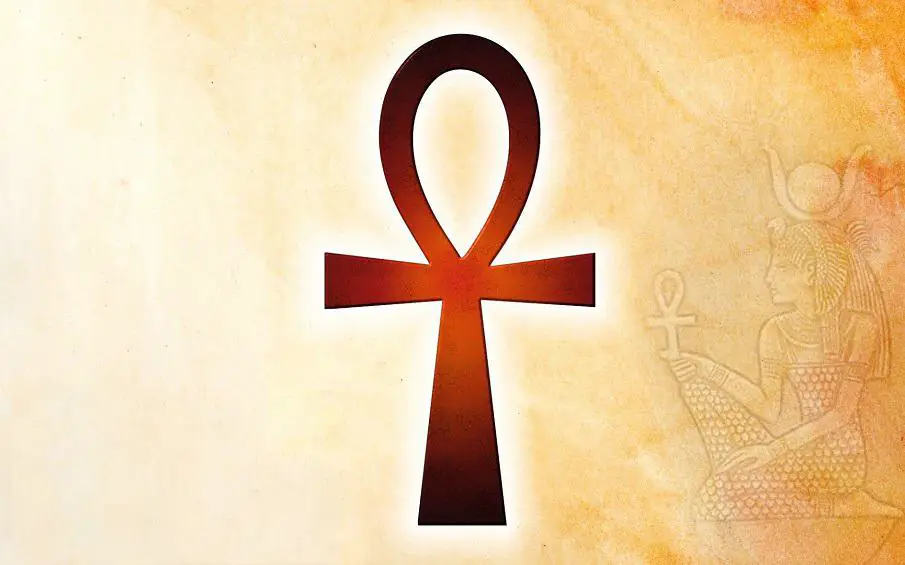
Without a doubt, one of the most famous symbols connected to the ancient Egyptian civilization is the Ankh ☥, also known as “crux ansata.” This ancient Egyptian hieroglyphic ideograph symbolizing “life.” Many Ancient Egyptian Gods are portrayed as carrying the Ankh by its loop. The symbol is often featured in hand or proximity of nearly every deity in the Egyptian pantheon, including in illustrations of the pharaohs. The Uraeus  Another popular symbol used in ancient Egypt was the Uraeus. The Uraeus is the stylized, upright form of an Egyptian cobra. The symbol represents sovereignty, royalty, deity and divine authority in ancient Egypt. The mask of Pharaoh Tutankhamun features a Uraeus. The Eye Of Horus  Another extremely well known ancient Egyptian Symbol is the so-called Eye of Horus ?. The symbol was widely recognized as an emblem of protection, royal power, and good health. In ancient Egypt, the Eye is personified in the goddess Wadjet, the patron and protector of Lower Egypt and upon unification with Upper Egypt, the joint protector, and patron of all of Egypt “goddess” of Upper Egypt. Horus is an ancient Egyptian God usually depicted as a falcon. Horus’ right eye was connected with the Sun God Ra. The Sesen-Lots Flower
Another ancient Egyptian symbol that represents life, creating, rebirth and the sun is the Sesen. This ancient Egyptian symbol is believed to have appeared during the Early Dynastic Period, although it became most popular from the Old Kingdom onwards. The Sesen is symbolized as a lotus flower which we see widespread in ancient Egyptian art. The Scarab  The Scarab was an extremely important ancient Egyptian symbol represented in the form of the dung beetle. The symbol was associated with the divine manifestation of the morning sun Khepri, who was believed to roll the disk of the morning sun over the eastern horizon at daybreak. The symbol of the Scarab was extremely popular in amulets and impression seals in the ancient Egyptian culture. The Djed  This symbol is considered one of the most ancient symbols of the Egyptian culture. The symbol represents stability and is associated with the God Ptah and Osiris. When representing Osiris, the symbol was often combined “with a pair of eyes between the crossbars and holding the crook and flail.” Furthermore, the Djed Pillar is the oldest symbol of Osiris and was of great religious significance to the ancient Egyptians. On a curious note, the ancient Egyptian maintained that the Djed Pillars were used in the four corner of the earth, keeping the earth in place. The Was—The Was Scepter  This is one of the ancient Egyptian symbols that was often depicted together with the Ankh Cross. The Was is believed to have represented a ceremonial staff. The Was symbol is depicted in the hands of a number of ancient Egyptian Gods, particularly Anubis and Set. On a personal note, it is one of the strangest symbols I’ve seen. Curiously, depending on how it was written, the symbol sometimes gave off the impression of being an emblem representing a being with an elongated head, a thin body. But that’s just me. Tyet—The Knot of Isis  The so-called tyet is an ancient Egyptian symbol connected to the goddess Isis. The symbol is eerily similar to the Ankh cross. The Tyet has arms that are curved downwards. It is believed it signifies welfare and life. During the early New Kingdom, Tyet amulets were buried with the dead. In Chapter 156 of the Book of the Dead, a New Kingdom funerary text, calls for a tyet amulet produced of red jasper to be put at the neck of a mummy, stating “the power of Isis will be the protection of [the mummy’s] body” and that the amulet “will drive away whoever would commit a crime against him.” The Ben-Ben  This ancient symbol is “the best-known symbol from ancient Egypt, after the ankh, even if one does not recognize the name.” As noted by ancient.eu, the ben-ben was the primordial mound upon which the God Atum stood at the beginning of creation. The symbol is connected to the pyramids, as these structures represent the ben-ben as the rise from the Earth towards the heaven. The Crook & Flail  Another extremely popular symbol in Ancient Egyptian art is the Crook and Flail. This symbol represents power and majesty of the king. Like many other symbols, this too was associated with Osiris and his early rule on Earth. Egyptian Pharaohs carried these symbols in important ceremonies. The coffinette of Tutankhamun has the Crook and Flail symbol represented on its surface. Akhenaten—Egypts most heretic ruler—was often depicted with the crook and flail. Officers followed the man as he fled on foot, instructing him to stop because he was being detained; the man pulled out a gun and pointed it at an occupied cruiser’s windshield
40,000 years ago, a mysterious people—possibly explorers—lived in Argentina. Archaeologists have uncovered remarkably well-preserved human remains that date back around 40,000 years in Argentina. These skeletal remains are not only the oldest in Argentina, but could be the oldest human remains ever discovered in South America. Don’t you just love when archeology digs up something like this? It changes everything, yet it changes nothing, The more we dig, the more we understand how little we know. A team of archaeologists led by professor Carlos Aschero had discovered what is believed to be evidence of the oldest human occupation in Argentina, and possibly in South America. The discovery was made in Antofagasta de la Sierra, a province of Catamarca, Argentina. Ancient Explorers? 40,000 years ago a group of people—possibly explorers—lived between the northwest of Catamarca and part of Salta, in the area that integrates the salty Puna. It is unknown how long the group remained in the Argentine Northwest, but their traces were very well preserved in the desert lands, at more than 3,500 meters above sea level. Antofagasta de la Sierra is almost 600 kilometers north of the capital of Catamarca. Its climate is rigorous, cold and dry, with minimum temperatures below 0 ºC. It is precisely the above-mentioned conditions that most likely made it possible for the remains to remain as well preserved as frozen over time. It was an extensive search. In fact, researchers excavated 4 kilometers in the upper section of the Punilla River, in a small ravine known as Cacao. More precisely in a cave which houses a huge variety of rock art and various stone structures. There, archaeologists recovered two strands of human hair, which had been cut. They also found stone tools used for cutting and scraping, copper earrings, as well as bone fragments (complete ribs and tooth remains). Previous to this discovery, the scientific community maintained that the oldest human presence in the area could be traced back around 10,000 years. However, the discovery offers new insight into the human population in the area, changing everything we thought we knew about South America and its early inhabitants. The tests used to determine the age of the skeletal remains were carried out in two specialized laboratories in the USA. (Arizona and CAIS-UGA) using radiocarbon dating. Jorge Martinez, an archaeologist at the National University of Tucumán and a researcher at the Higher Institute of Social Studies of CONICET, said that the oldest traces of human presence in Argentina prior to this, were located in the province of Buenos Aires (Pampean region), and can be traced back to around 14,000 years. Meanwhile, in Latin America in general, the oldest alleged human remains are located in Piedra Furada (Brazil), these remains date back between 27,000 and 30,000 years. However, Martínez believes that the skeletal remains discovered in Brazil are very controversial, among other things due to the method by which their age was determined. According to reports, scientists used Radiometric dating to determine the age of the skeletal remains from Brazil. Radiometric dating is a technique used to date materials such as rocks or carbon, in which trace radioactive impurities were selectively incorporated when they were formed, reports El Litoral. DNA tests will reveal more Martinez looks forward to learning more about the skeletal remains discovered in Argentina after DNA tests result are done. Experts will then know who these mysterious people were, and to what genetic lineage they belong to. “The theory that prevails is that the inhabitants of America came from Asia through the Bering Strait and that they belong to four great lineages. We want to corroborate or refute that origin, perhaps we will find they belong to a different ancestry,” he ventured out saying. These discoveries offer a wealth of previously unknown information to experts. “It means that the settlement processes were pervasive and diverse. And those records correspond to the Puna, where there is a lot of height and a complicated climate. What can we imagine of the occupation that could have existed in much lower areas, where life is easier! “, Professor Aschero surmised. Source: TELAM Article originally posted by ipetricevic.com. Reprinted with permission. “We are extremely fortunate this suspect did not seriously injure or kill our officers, herself, her passenger or anyone else,” said Royal Oak Police Chief Michael Moore
Three people were arrested for their part in the plan to steal the SUV, which had more than 150 pounds of marijuana hidden inside
YouTube Video Here: https://www.youtube.com/embed/quUtlWTB_dc?feature=oembed&enablejsapi=1 If you travel to the Giza plateau, you should know that there are many incredible things to explore, in addition to the three main pyramids. One such fantastic feature is the so-called Tomb of Osiris, or commonly referred to as the Osiris Shaft. Located beneath the stone causeway of the Pyramid of Khafre, this enigmatic tomb is a mysterious structure composed of various intricately carved levels beneath the surface. Despite the fact that its existence has been known for a few years, it wasn’t until recently that the structure was adequately excavated and documented. In ancient times, the shaft was used by people as a swimming hole since it was filled with water. Selim Hassan and his team were one of the first to explore the shaft in the 1930‘s, but it wasn’t until 1999 when the structure was fully excavated by Zahi Hawass. By 1999 the water levels at the Giza plateau had lowered to the point that a detailed excavation was possible. Here is Selim Hassan’s description of the Osiris Shaft: Selim Hassan’s 1933-34 excavations report for Giza.
It was revealed that the shaft is composed of three different levels. The first level was found to be empty. The second level is a tunnel that leads into a room with six other chambers carved out of the stone walls. Inside these chambers, researchers have recovered pottery sherds, ceramic beads, and ushabtis (small servant figurines). Furthermore, basalt sarcophagi were found in Chambers C, D, and G; badly decomposed skeletal remains were found in the sarcophagi in Chambers C and G. Based on stylistic grounds the artifacts, sarcophagi included, date to Dynasty 26 (ibid: 386-87).  In the lowest chamber of the Osiris shaft, some 30 meters below the surface lies a mystery described by Herodotus, which was written off as a myth by mainstream scholars. However, it turned out that Herodotus was right all along, and mainstream scholars were wrong. The lowest chamber of the shaft is a sort of subterranean hall, and inside it lies a sarcophagus, perfectly preserved and empty. The third level of the Osiris Shaft is found to be more complex regarding design and architecture. The most important discovery made in the third level of the Osiris Shaft was red-polished pottery, containing traces of white paint. Experts managed to date back the pottery remains to the 6thy dynasty, from the end of the Old Kingdom. This means that the pottery recovered in the third level is, in fact, the oldest possible datable material in the entire complex. Based on research and archeological evidence recovered throughout the years, the Osiris Shaft is believed to date originally from the Old Kingdom, more precisely to the Sixth Dynasty (2355-2195 BCE). The Osiris shaft was opened to the public for the first time in 2017. Recently, author and researcher Brien Foerster explored the Osiris Shaft. The result? A magnificent insight into the mysterious shaft proving that despite the fact that we know a lot about ancient Egypt, there are many details we have still not uncovered. Check out the video: Brien Foerster and his team will return to the Giya plateau in April 2019. For more information check this out. Zahi Hawass’s essay about the Osiris Shaft can be downloaded from this link: The Discovery of the Osiris Shaft at Giza. |
||
|
Copyright © 2026 Paranormal News Network - All Rights Reserved Powered by WordPress & Atahualpa 105 queries. 0.112 seconds. |
||