There are high hopes for quantum computers: they are supposed to perform specific calculations much faster than current supercomputers and, therefore, solve scientific and practical problems that are insurmountable for ordinary computers. The centerpiece of a quantum computer is the quantum bit, qubit for short, which can be realized in different ways—for instance, using the energy levels of atoms or the spins of electrons.
|
|
||
|
Class A; July 2025; Florida, Levy County
“It’s not a mask, it is just simply a face covering, which is for our … tactical teams because they do some dangerous stuff sometimes,” Iredell County Sheriff Darren Campbell said
Southwest Research Institute (SwRI) has developed and tested a micrometeoroid and orbital debris (MMOD) detection and characterization system designed for satellites and spacecraft to monitor impacts from space debris. The system provides critical post-impact data, ensuring awareness of an impact even when damage is not immediately apparent.
We already know a decent amount about how planets form, but moon formation is another process entirely, and one we’re not as familiar with. Scientists think they understand how the most important moon in our solar system (our own) formed, but its violent birth is not the norm, and can’t explain larger moon systems like the Galilean moons around Jupiter. A new book chapter, also released as a preprint paper on arXiv, by Yuhito Shibaike and Yann Alibert from the University of Bern, discusses the differing ideas surrounding the formation of large moon systems, especially the Galileans, and how we might someday be able to differentiate them.
Researchers at NPL have reported a novel high-speed charge sensing method for ballistic electrons, a potentially useful technique in the fields of electron quantum optics, quantum electrical metrology, flying qubit technology, and signal sensing.
By analyzing the data from the James Webb Space Telescope (JWST) and the Hubble Space Telescope (HST), astronomers from the University of Wisconsin-Madison and elsewhere have probed the properties of a massive and old galaxy designated SMILES-GS-191748. Results of the study, published August 7 on the pre-print server arXiv, shed more light on the nature of this galaxy.
A team of international researchers from the Helmholtz-Zentrum Dresden-Rossendorf (HZDR), Johns Hopkins University and Duke University has discovered that a century-old theory describing turbulence in fluids also applies to a very bubbly problem: how rising bubbles stir the water around them.
A ‘lost’ 2.000-year-old underground city has been unearthed by experts in Iran, what they found inside was completely unexpected and terrifying.  Located in the area near the city of Samen, archaeologists excavated the remains of around 50 large underground rooms that served as houses some 2,000 years ago. The discovery of the underground city in is incontrovertible evidence that archeology is a science that requires extreme patience in order to obtain valuable rewards. After 12 years of excavations, researchers have finally announced the existence of countless artifacts, skeletons and more than 50 rooms of different sizes connected by tunnels, intricately built some 2,000 years ago—dating back to the period of the fall of the Achaemenid Empire (550-330 BC) and the rise of the Parthian Empire (247 BC-224 AD).  The Parthians largely adopted the art, architecture, religious beliefs, and royal insignia of their culturally heterogeneous empire, which encompassed Persian, Hellenistic, and regional cultures. However, the most terrifying part is that experts have found around 60 skeletons within the complex. Scientists are still unsure as to what happened to the underground city and why it was abandoned. Its residents worshiped Mithra, the ancient Iranian god of the Sun.  This discovery marks one of the several exciting findings by Iranian archeologists in recent months. Recently, experts also discovered a set of underground living chambers carved into a mountain in central Iran, dating back to the 12th century. Furthermore, in February of 2017, experts excavated the remains of an ancient observatory which is believed to date back to the Sassanian dynasty (224 to 651CE.)  According to experts, it seems that Samen was used for various purposes during different eras. In its first phase, when the intricately carved underground complex was founded, it officiated as a place of religious ceremonies. Later, during the Ashkani period, the city served as a cemetery and as an emergency shelter. So far, archaeologists have unearthed 50 rooms of various sizes connected by tunnels. These rooms and chambers were built at a depth of between 3 and 6 meters and supposedly belonged to different families.  The excavations will continue with the hope of discovering more rooms and learning more about this ancient city that is already shaping up as a World Heritage Site in Iran. So far experts have discovered several underground cities across the planet. The most notorious are those found in modern-day Turkey—like Derinkuyu. In 1963 what was supposed to be just another a simple home renovation in the town of Derinkuyu actually led to one of the most important discoveries in the history of Turkey. When a cave wall was opened, it revealed a passageway to an underground city that is thousands of years old, over 280 feet deep. Over 15,000 ventilation shafts spread throughout the city bringing air from the surface, providing ideal living conditions for up to 30,000 people. The officers were responding to a domestic disturbance call in Tremonton; after the officers were shot, bystanders persuaded the man to put down his weapon
The idea that advanced ancient civilizations existed on Earth in the distant past has captured the interest of authors, historians, and archaeologists across the globe. Every once in a while, experts make discoveries that completely change everything we know about history. What if, in the distant past—as far as 100,000 years ago—Earth was inhabited by civilizations that were completely different from what we are today?  Do you believe that Intelligent civilizations lived on Earth over 100,000 years ago? Many controversial discoveries point to the possibility that hundreds of thousands of years ago, advanced civilizations roamed our planet. What do we really know about history and the past of the human race? Has mankind been on planet Earth only a couple of thousands of years as mainstream researchers suggest? Or is it possible that advanced ancient civilizations inhabited our planet hundreds of thousands of years ago? Recently, several discoveries seem to point to that possibility. Why mainstream researchers opted to ‘ignore’ details and clues which point towards the existence of civilizations that are much older than we previously believed is still an enigma for a lot of people. Evidence of civilizations that inhabited our planet ‘before recorded history’ can be found in all corners of the world. In Ancient Egypt, Mesoamerica and Sumeria we find written texts that speak of great civilizations, great rulers, and a ‘golden age’ that lasted for thousands of years. Evidence of civilizations that inhabited our planet ‘before recorded history’ can be found in all corners of the world. In Ancient Egypt, Mesoamerica and Sumeria we find written texts that speak of great civilizations, great rulers, and a ‘golden age’ that lasted for thousands of years. Let’s take a trip to Africa, there, we will find evidence of a major ancient settlement that predates our entire history. Intelligent civilizations inhabited Africa over 100,000 years ago
Around 150 km west of port Maputo, we find the remains of a huge metropolis that measures, according to initial studies, around 1500 square kilometers. This ancient city is according to researchers, part of an even larger community with about 10,000 square kilometers, believed to have been constructed between 160,000 to 200,000 years before Christ. The surrounding geology is interesting due to numerous gold mines located in the vicinity. Researchers have proposed that a missing civilization from the distant past, could have lived and proposed in that part of the world while mining gold. Researchers point to the Ancient Anunnaki.
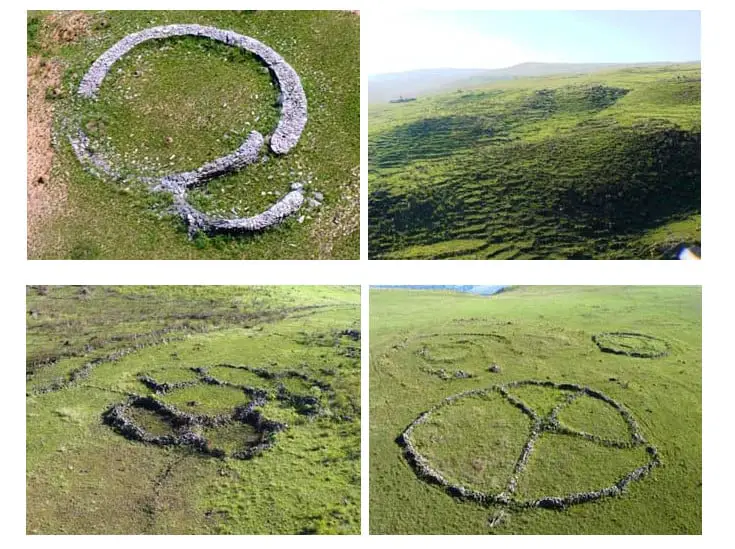
Lost civilizations in the Amazon?Is this another civilization that predates the Inca and their ancestors? No one could have imagined that somewhere, in the remote areas of the Amazon, a lost civilization would be found. Rapid deforestation in combination with Google Earth has allowed the detection of 210 geoglyphs in 200 different site sites, in a strip of 250 kilometers by 10 kilometers in the Amazon. Just like the Nazca lines, the incredible geometric, zoomorphic and anthropomorphic designs of the Amazon can only be truly appreciated from the air. The question remains, why? The question remains, why? Numerous remains of what is obviously part of an ancient and hitherto unknown civilization have appeared under the trees of the Amazonian rainforest. According to researchers, 260 huge avenues, long irrigation canals, and fences for livestock have been spotted from the air. The discovery was made in the vicinity of the border between Bolivia and Brazil. The lost pyramids of the Amazon: Traces of a prehistoric civilization!
In the tangled and dense jungles of the Amazon, there are numerous mysteries that could probably help us understand how ancient civilizations lived in the distant past. Even thought that several researchers believe that the Pyramids of Paratoari are truncated ridge spurs, which can take the form of natural pyramids, there are many other researchers who firmly believe that these structures were built in the distant past by a civilization that completely been ignored by mainstream history Excursions to the region found plenty of evidence of Incan inhabitance in the area, such as petroglyphs, paved roads, and platforms. The mysterious pyramidal structures were first identified via NASA satellite photograph number C-S11-32W071-03, released in 1976. The images caused numerous researchers to venture to the Manu area of dense tropical rain forest in southeast Peru in hopes to find out whether these structures were actually built by an ancient civilization, lost in time. The Sphinx, an 800,000-year-old monument? One of the most mysterious and enigmatic monuments on the surface of the planet is without a doubt the Great Sphinx at the Giza plateau in Egypt. It is an ancient construction that has baffled researchers ever since its discovery and until today, no one has been able to accurately date the Sphinx, since there are no written records or mentions in the past about it. Now, two Ukrainian researchers have proposed a new provocative theory where the two scientists propose that the Great Sphinx of Egypt is around 800,000 years old. A Revolutionary theory that is backed up by science. The authors of this paper are scientists Manichev Vjacheslav I. (Institute of Environmental Geochemistry of the National Academy of Sciences of Ukraine) and Alexander G. Parkhomenko (Institute of Geography of the National Academy of Sciences of Ukraine). The starting point of these two experts is the paradigm shift initiated by West and Schoch, a ‘debate’ intended to overcome the orthodox view of Egyptology referring to the possible remote origins of the Egyptian civilization and, on the other, physical evidence of water erosion present at the monuments of the Giza Plateau. The truth is that we have very little knowledge when it comes to the origins of live and modern civilization. In a recently published study, experts concluded that DIFFERENT ‘Complex’ life forms may have once existed on Earth before our species came into existence. “This research shows that there was enough oxygen in the environment to have allowed complex cells to have evolved…” According to scientists, we are not the FIRST complex life forms on planet Earth. In fact, another complex life form existed once but disappeared at some point during Earth’s long history. Then, after a while, complex life forms reappeared. Mainstream scholars agree that given our ‘current’ knowledge of Earth’s history, complex life appeared on our planet at least some 1.75 BILLION years ago. So, if complex life could have existed on Earth in the distant past, why is it so improbable and unlikely that advanced civilizations flourished on Earth? Curiously, according to Jason Wright, assistant professor of astrophysics and astronomy of the Pennsylvania State University ‘technological’ alien civilizations may have once lived on one of the planets in our solar system, and eventually disappeared without a trace. In a study titled ‘Prior Indigenous Technological Species’, Professor Wright proposes that ancient aliens may have even lived on either Mars, Venus or Earth. The scientific paper—which has been published in arXiv—states: A prior indigenous technological species might have arisen on ancient Earth or another body, such as a pre-greenhouse Venus or a wet Mars. However, if these advanced alien civilizations existed in our solar system—perhaps even Earth—most evidence of their existence is probably gone by now. Class A; August 2025; Maine, Oxford County
The great Sphinx of Giza is considered an ancient marvel not only because of its size and confusing design but because of the countless mysteries that surround this ancient structure. Did you know that the Ancient Egyptians have no records about the Sphinx being built? Curiously, this ancient monument was discovered–almost entirely buried in Sand—in 1817, when the first modern archaeological dig, led by Giovanni Battista Caviglia managed to uncover the Sphinx’s chest completely. This ancient monument has captured the imagination of not only archaeologists but scientists and tourists who have visited this ancient statue since time immemorial. Let’s take a look at some of the most interesting facts about the Sphinx, you most likely didn’t know.
The Great Sphinx of Giza faces the rising Sun. Whoever built the Great Sphinx, wanted it to be aligned. The Sphinx is oriented due east facing the rising sun near the 30th parallel. According to some texts, ancient Egyptians referred to the Sphinx as balhib and bilhaw. Circa 1500 B.C.E. it was referred to as Hor-em-akht – Horus in the Horizon, Bw-How Place of Horus and also as Ra-horakhty Ra of Two Horizons. The Arabs knew the Sphinx as Abu al-Hawl (Father of Terror), which apparently is identified with the ancient Greek myth. The Great Sphinx of Egypt is considered the largest single-stone statue in the world and around 200 tons of stone were quarried in the construction phase to build the temple next to it. The Great Sphinx originally had a beard, several pieces of the beard of the Sphinx are located in the British Museum in London and the Cairo Museum. Author Robert K. G. Temple proposes that the Sphinx was originally a statue of the Jackal-Dog Anubis, the God of the Necropolis, and that its face was recarved in the likeness of a Middle Kingdom pharaoh, Amenemhet II. First-century writer Pliny the Elder mentioned the Great Sphinx in his Natural History, commenting that the Egyptians looked upon the statue as a “divinity” that has been passed over in silence and “that King Harmais was buried in it. Geologists and scholars agree that in the distant past Egypt was subjected to severe flooding, thus water erosion is present on the construction of the Sphinx. Wind erosion cannot take place when the body of the Sphinx is covered by sand. Edgar Cayce, a modern prophet—also known as the modern-day Nostradamus—prophesied in 1932 that the Sphinx was built in 10500 BCE by the Ancient Atlantean civilization. Furthermore, he stated that a secret room is located underneath it called the ‘Hall of Records’ containing the secrets and wisdom of the ancient Atlantean civilization and the human race. The Hall of Records is said to house the knowledge of the Ancient Egyptians documented in ancient papyrus scrolls and is believed to account for the history of the lost continent of Atlantis, as well as its location. Compared in importance, the Egyptian Hall of Records is just as the Great Library of Alexandria, which housed Grecian Knowledge. Charles Thompson, who explored the Sphinx in 1733, mentioned entrances and a “hole in the top of the back” of the Sphinx. There are three passages into or under the Sphinx, the “Tomb of Osiris” is one of the most incredible discoveries linked to the Sphinx, located 95 feet below the surface behind the back of the Sphinx. It is believed to be the resting place of Egyptian God Osiris. Interestingly, in 1987 a Japanese team from Waseda University (Tokyo), under the direction of Sakuji Yoshimura carried out an electromagnetic sounding survey of the Khufu Pyramid and Sphinx. Experts discovered: A. South of the Sphinx. The Japanese indicated the existence of a hollow 2.5 m. to 3 m. underground. And, they found indications of a groove on the Sphinx body that extends beneath the Sphinx. B. North of the Sphinx. The Japanese found another groove similar to the southern one which may indicate that maybe there is a tunnel underneath the Sphinx connecting the south and north grooves. C. In front of the two paws of the Sphinx. The Japanese found another hollow space about 1 m. to 2 m. below surface. Again, they believe that it might extend underneath the Sphinx. According to secrethistoy.wikia.com, there is also documented evidence of a large rectangular entrance on top of the hips at the back of the sphinx. In 1995, workers renovating a nearby parking lot uncovered a series of tunnels and pathways, two of which plunge further underground close to the Sphinx. In 1857, Auguste Mariette, founder of the Egyptian Museum in Cairo, unearthed the much later Inventory Stela (estimated Dynasty XXVI, c. 678–525 BC), which tells how Khufu came upon the Sphinx, already buried in sand. The inventory stela—made of polished granite and decorated with a commemorative inscription and a so-called apparition window—was found in Giza during the 19th century. The stela presents a list of 22 divine statues owned by a Temple of Isis, and goes on to claim that the temple existed since before the time of Khufu (c. 2580 BC). The stela was discovered in 1858 at Giza by the French archaeologist Auguste Mariette, during excavations of the Isis temple. The tablet was located very close to the Great Sphinx of Giza. This ancient stela points to the possibility that the Great Sphinx of Giza was built before the reign of Khufu and not by him. The Stela reads:
According to a study presented at the International Conference of Geoarchaeology and Archaeomineralogy held in Sofia titled: GEOLOGICAL ASPECT OF THE PROBLEM OF DATING THE GREAT EGYPTIAN SPHINX CONSTRUCTION, there is conclusive evidence to suggest that the Great Sphinx of Giza dates back 800,000 years. However, there are Geological findings that indicate that the Sphinx may have been sculpted sometime before 10,000 BC, a period that coincides with the Age of Leo, or the Lion, which lasted from 10,970 to 8810 BC. According to Graham Hancock, computer simulations show that in 10,500 BC the constellation of Leo housed the sun on the spring equinox – i.e. an hour before dawn in that epoch Leo would have reclined due east along the horizon in the place where the sun would soon rise. This means that the lion-bodied Sphinx, with its due-east orientation, would have gazed directly on that morning at the one constellation in the sky that might reasonably be regarded as its own celestial counterpart. Interestingly, Gaston Maspero, a French Egyptologist known for popularizing the term “Sea Peoples” in an 1881 paper, wrote in the book the Dawn of Civilization “… the Sphinx could have existed since the days of the followers of Horus,” a race of predynastic and semi-divine beings, which, according to beliefs of the ancient Egyptians had ruled thousands of years before the Pharaohs of Egypt.” (source) No. Evidence. Whatsoever. The Ancient Egyptians were splendid record keepers. In fact, they made it sure to write down nearly everything so future generations could appreciate their accomplishments. Strangely, there are no written texts that speak about the Sphinx. It is as if the Great Sphinx wasn’t built by the Ancient Egyptians. Residues of red pigment are visible on areas of the Sphinx’s face. Traces of yellow and blue pigment have been found elsewhere on the Sphinx, leading Mark Lehner to suggest that the monument “was once decked out in gaudy comic book colors” During a traffic stop, the man resisted arrest, disarmed multiple officers and fired a shot that wounded one before Lansing police returned fire
Total crime is down 27% in 2025, with Syracuse PD officers walking beats and working alongside community intervention teams
|
||
|
Copyright © 2026 Paranormal News Network - All Rights Reserved Powered by WordPress & Atahualpa 112 queries. 0.179 seconds. |
||