On July 2, 2025, NASA’s Fermi Gamma-ray Burst Monitor (Fermi-GBM) captured around three hours’ worth of signals that appeared to come from the same source. When scientists compiled this data with signals picked up by multiple other instruments, like the Einstein Probe (EP) Wide-field X-ray Telescope and the Russian gamma-ray spectrometer, Konus-Wind, they found that they were dealing with the longest gamma ray burst (GRB) ever recorded. At around 25,000 seconds in duration (around seven hours), the GRB event scientists refer to as “GRB 250702B” beat out the prior record-holder, GRB 111209A, by 10,000 seconds.
|
|
||
|
Quantum information systems, systems that process, store or transmit information leveraging quantum mechanical effects, could, in principle, outperform classical systems in some optimization, computational, sensing, and learning tasks. An important aspect of quantum information science is the reliable quantification of quantum states in a system, to verify that they match desired (i.e., target) states.
Pulsars suggest that ultra–low-frequency gravitational waves are rippling through the cosmos. The signal seen by international pulsar timing array collaborations in 2023 could come from a stochastic gravitational-wave background—the sum of many distant sources—or from a single nearby binary of supermassive black holes.
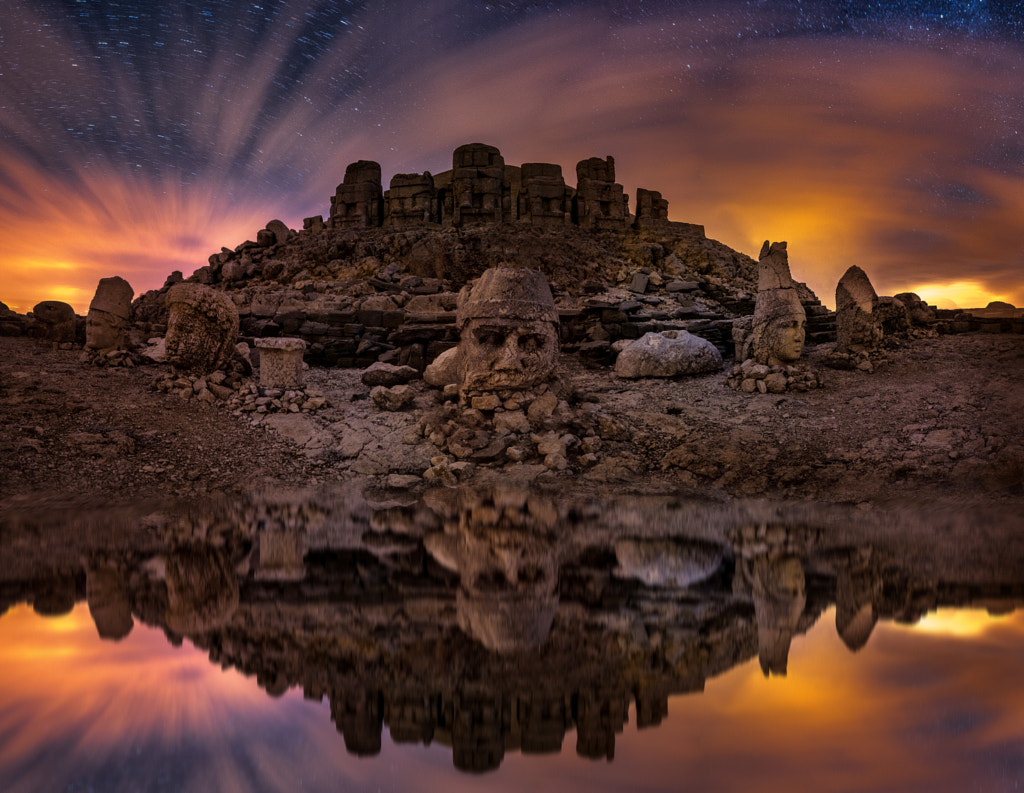
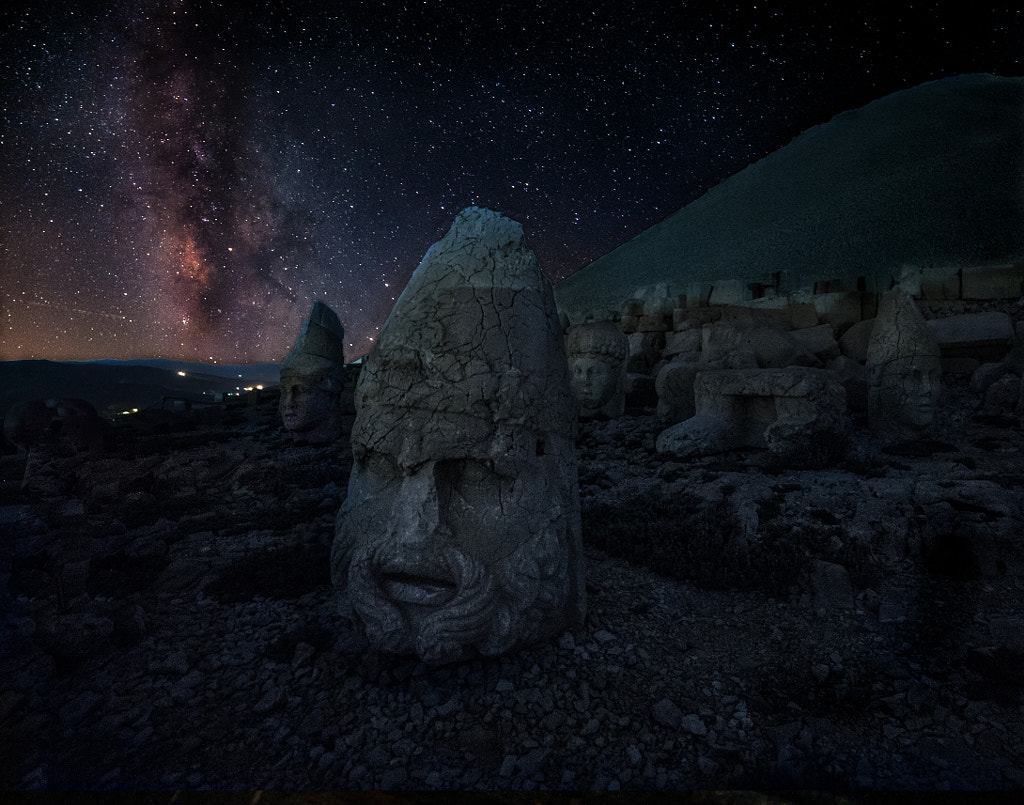
YouTube Video Here: https://www.youtube.com/embed/Lq89er-ETQU?feature=oembed&enablejsapi=1 Located in Southeastern Turkey, more than 2,000 meters above sea level on Mount Nemrut, lie the ancient ruins of the lost Kingdom of Commagene. Thousands of years ago, to be more precise in 62 BC, Kling Antiochus erected a mysterious royal sanctuary there and made sure it would forever be remembered. Supermassive statues of lions, Eagles, Persian and Greek Gods, as well as sculptures of the king himself, were built imposingly. Three terraces, to the North, East, and West, surround the 50 meters high mound (145 meters in diameter) formed by small limestones: On the East terrace, we find two rows of stone stelae with sculptures in relief: one of them with the Macedonian ancestors of Antiochus I and another with their Persian ancestors. On the west terrace, there is also a row of stelae, where Leo’s horoscope and Antiochus I himself is shown shaking hands with a deity. On the north terrace, the existing stelae have neither reliefs nor inscriptions.
Archaeologists have found evidence that the statues were once seated, with names of each god inscribed on them. Now, the heads of the statues are scattered on the ground; damage to the heads (especially the noses) suggests that they were deliberately produced by iconoclasts. There are also stone slabs with bas-relief figures that are thought to have been part of a large frieze. Statues that depict King Antiochus shaking hands with the ‘Gods,’ as if the gods recognize him as one of their own, welcoming him to the stars. This royal sanctuary, as well as the kingdom, were strangely abandoned in the first century AD. So far, experts have not discovered the king’s legendary burial chamber. Researchers did, however, find a shaft that King Antiochus had built into the mountain, which according to experts, displays exceptional knowledge of advanced astronomy. The shaft runs into the mountainside at an angle of 35 degrees to the horizontal, and it is believed to be about 150 meters long. Curiously, there’s nothing at the bottom. Computer analysis has revealed that on two days of the year, the sun’s rays would illuminate the bottom of the shaft; once when in line with the constellation of Leo and once when in line with Orion. This is a particularly exciting area in the night sky since it happens to be the path where the sun crosses over the Milky Way galaxy. Curiously, this to the ancient world was known as the Gate of Heaven. Even more interesting is the fact that there were Gates to Heaven; one where they cross in the north and the other where they cross in the south. More from Great Big Story Featured image credit: Shutterstock. In science and engineering, it’s unusual for innovation to come in one fell swoop. It’s more often a painstaking plod through which the extraordinary gradually becomes ordinary.
Researchers at the Niels Bohr Institute, University of Copenhagen, steered very thin conductors from superconductivity to insulation—creating an “impossible,” strange state between the two mutually exclusive states.
Explosive volcanic eruptions on early Mars may have transported water ice to equatorial regions, according to a modeling study published in Nature Communications. The authors suggest that these eruptions could have led to conditions that allow these ice deposits to still exist under the surface today, which would expand our knowledge of Mars’s terrain for future exploration.
The Myrtle Beach officer made the “conscious decision to fire his weapon even though the sidewalk was crowded” in order “to protect the lives of innocent bystanders,” according to the report
Modularity is taking off in more ways than one in space exploration. The design of the upcoming “Lunar Gateway” space station is supposed to be modular, with different modules being supplied by different organizations. In an effort to extend that thinking down to rovers on the ground, researchers at Germany’s space agency (DLR), developed an architecture where a single, modular rover could be responsible for both exploration and carrying payloads around the moon or Mars. The study is published in Acta Astronautica.
It’s great to see old astronomical observations come to light. Not only can these confirm or refute what’s known about historic astronomical events, but they can describe what early observers actually saw.
Muon beams can now be created in a device that is the length of a ruler.
Did life really exist on Mars after all? Unfortunately, there is no conclusive evidence for this yet. Nevertheless, it would seem that some form of life was the driving force behind the mysterious Martian dune gullies. Earth scientist Dr. Lonneke Roelofs from Utrecht University has investigated how these gullies were formed. In a test setup, she observed that blocks of CO2 ice “dug” these gullies in a unique way.
White dwarfs are the compact remnants of stars that have stopped nuclear burning, a fate that will eventually befall our sun. These extremely dense objects are degenerate stars because their structure is counterintuitive: the heavier they are, the smaller they are.
A pair of Sydney Ph.D. students helped sharpen the view of humanity’s most powerful space observatory—without leaving Earth. As an indelible reminder of this thrilling result, Louis Desdoigts, now a postdoctoral researcher at Leiden in the Netherlands, and his colleague Max Charles, had tattoos of the instrument their work has repaired inked on their arms.
|
||
|
Copyright © 2026 Paranormal News Network - All Rights Reserved Powered by WordPress & Atahualpa 98 queries. 0.126 seconds. |
||