Duplicating expensive resources is expensive and wasteful, and most people would agree it’s unnecessary. However, the planned increase in major satellite constellations is currently causing a massive duplication of resources as individual companies and even countries try to set up their own infrastructure in space.
|
|
||
|
Astronomers have captured the clearest picture yet of how massive stars are born, revealing a dramatic interplay between gravity and magnetic fields in some of our galaxy’s most dynamic star forming regions. A team led by Dr. Qizhou Zhang from the Center for Astrophysics | Harvard & Smithsonian used the Atacama Large Millimeter/submillimeter Array (ALMA) to conduct the largest and most detailed survey to date of magnetic fields in 17 regions where clusters of massive stars are forming.
Every time you check the time on your phone, make an online transaction, or use a navigation app, you are depending on the precision of atomic clocks.
Imagine zooming into matter at the quantum scale, where tiny particles can interact in more than a trillion configurations at once.
Cornell researchers have built a programmable optical chip that can change the color of light by merging photons, without requiring a new chip for new colors.
For decades, scientists have observed, but been unable to explain, a phenomenon seen in some soft materials: When force is applied, these materials exhibit not one, but two spikes in energy dissipation, known as overshoots. Because overshoots are generally thought to indicate the point at which a material yields, or transitions from solid-like to fluid-like behavior, the dual response was therefore assumed to indicate “double yielding”—the idea that to fully fluidize a material, it needed to yield twice.
For decades, it’s been known that subtle chemical patterns exist in metal alloys, but researchers thought they were too minor to matter—or that they got erased during manufacturing. However, recent studies have shown that in laboratory settings, these patterns can change a metal’s properties, including its mechanical strength, durability, heat capacity, radiation tolerance, and more.
In the end, it doesn’t even matter, whether Jesus of Nazareth was white or black. However, speaking in a historical context, maybe its time to ask what was Jesus Christ really like? What color was his skin? Why is Jesus depicted as a having long hair, a beard and of white skin? Was Jesus’ representation always like that? Or did it change throughout time? The answer may surprise you. Most Historians and Biblical scholars firmly agree that Jesus of Nazareth, born in what is today the capital and the largest city in the Northern District of Israel. In the New Testament, the town is described as the childhood home of Jesus, and as such is a center of Christian pilgrimage, with many shrines commemorating biblical events. 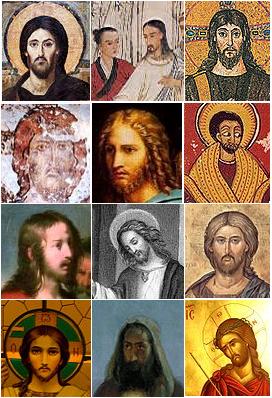 This historical fact may shed light on the appearance of Jesus of Nazareth. Is it possible that he had a Middle Eastern Appearance? Despite His most likely middle-eastern appearance, it has been proven controversial among many experts who argue that Jesus was a white man. In historical records, we find only a few description of Bible, and those that exist look more towards his divinity and Power, rather than accurately describing his ‘mortal’ appearance. So, how can we know what Jesus looked like?  Most experts agree that in order to understand what Jesus might have looked like we should turn towards the area where He was born. It is believed that the ancient Jews looked very similar to their Middle-Eastern neighbors, being characterized by having dark skin and hair. Interestingly, many of the earliest representations of Christ are illustrated in this way, where the artist emphasized on Jesus Christ’s Semitic origins. However, through the years this changed and the way Jesus was illustrated changed drastically. Science takes a lookRichard Neave, a scientist at the University of Manchester, has spent a good part of his time trying to reconstruct the face of Jesus of Nazareth through forensic anthropology, one of the subdisciplines of physical anthropology. It is not the first time that the professor has done a job of this kind, he had previously reconstructed the face of other very popular historical figures, such as Philip II of Macedonia (father of Alexander the Great) and King Midas. To make an image of Jesus more adapted to reality, the scientist counted on three well-preserved first-century skulls that had been found in Israel. From them, Neave used the computerized tomography to try to obtain even the smallest detail.  We are used to seeing representations of Jesus of Nazareth that show him with chestnut hair, white skin, light eyes and a beard. But science now questions that very Caucasian aspect and claims that His skin color was black, He had a larger nose and also, a much more corpulent appearance. As explained in Popular Mechanics, scientists believe that this recreation of Jesus could be the most accurate that has been done to date. According to Alison Galloway, professor of anthropology at the University of California, “it is probably truer to reality than the work of many great masters of painting.” So, if we know that Jesus was not white, why are we still depicting Him as a white man, brown hair, and a beard? When Emperor Constantine converted to Christianity, and the religion spread across the Roman Empire, the classic representation of Jesus of Nazareth began to change. Roman artists started depicting Jesus with long brown hair, with a beard, and white, only to emphasize His connection with the people of the Roman Empire and Europe. Over the centuries this trend would spread across the continent, and the world, where Jesus was depicted as looking more like a Central European man, than someone born in Nazareth. Featured image credit: Composition-Shutterstock “These individuals’ behavior was completely destructive, dangerous and against the law,” Gov. Maura Healey said
“Protesters turned on police, kicking a marked cruiser, assaulting officers, blocking traffic and setting off devices causing red smoke in the air,” Boston PD Sgt. Det. John Boyle said
“Just in the last four and a half years, we’ve lost over 15,000. That’s a staggering number,” said Patrick Hendry, president of the NYC Police Benevolent Association
Sikeston Officer Henry Franklin was killed during a SWAT operation when a barricaded suspect opened fire from inside a home as officers attempted to serve a warrant
The idea that early mankind was influenced by beings, not of Earth has widely spread in modern society. With the emergence of the so-called Ancient Astronaut Theory, people have started questioning whether it is possible that in the distant past, perhaps tens of thousands of years ago, ancient mankind was visited by otherworldly beings, by spacefaring civilizations, which came to earth and helped instigate humankind. https://www.youtube.com/watch?v=3ANBKyPMfoY On Earth, evidence of alien contact is, according to many, vast. Many ancient sites on Earth defy explanation. For centuries have experts tried unraveling the mysteries how some of these sites were built. Scholars have wondered about how ancient civilizations had the ability to move supermassive blocks of stones, for hundreds of kilometers, from their quarries to the construction sites. They have tired solving the mystery of how they quarried some of these rocks, and with what kind of tools. The more they searched, the more questions arose. Since many questions were left unanswered, some people have started wondering whether some of these sites may have actually been built by aliens? Sacsayhuaman—an ancient alien fortress?  Located outside of Cusco is a massive ancient fortress called Sacsayhuaman. This ancient site was built with supermassive stones that have been chiseled and put into place like an enormous jigsaw puzzle. The ancient fortress walls are composed of Andean rocks that weigh more than 300 tons each, and were carried—transported—from more than 50 kilometers away. Furthermore, somehow these massive stones were lifted and fitted into place with laser-like precision. Many people argue that cutting, transporting and fitting 300-ton-stones is something that the ancients could have achieved, but only with the help of interstellar visitors. While personally, I believe that the builders of Sacsayhuaman were of terrestrial origin, I believe they had in their possession advanced ancient technologies that allowed them to achieve such incredible feats. Teotihuacan—the city of Gods 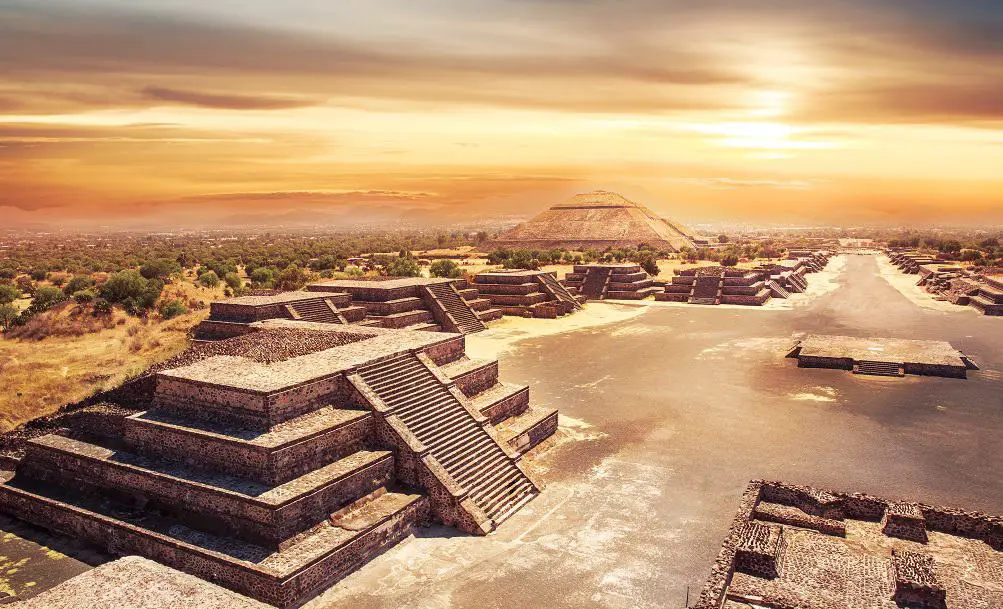 Teotihuacan is a massive ancient city best known for it massive pyramid complex and incredible astronomical alignment. The city of the Gods was created thousands of years ago, and its design, architecture, and mysterious characteristics have led many people to believe it was built not by human hands. One of the most massive structures in Teotihuacan is the Pyramid of the Sun. Interestingly, this structure is also one of the largest such constructions in the Western Hemisphere. Furthermore, the pyramid’s curious alignment is believed to be based on calendrical cycles. The Pyramids of Giza 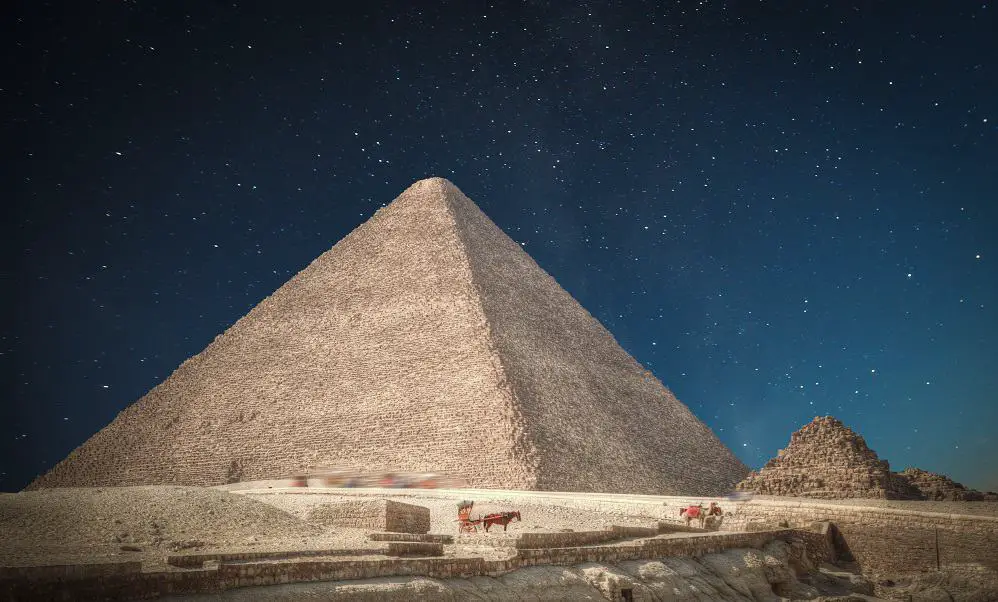 How the Pyramids of the Giza plateau were built remains an unsolved mystery. Despite the fact that there is written evidence which explains how some of the blocks were transported to the pyramid, archaeologists really don’t know how the pyramid was built. How did the ancient Egyptians stack the massive blocks of stones? How did they move them as the pyramid grew? What was the true purpose of the pyramid? Why is it that the three main pyramids are aligned with Orion? Why haven’t experts found a mummy inside the pyramid, if it was built as a resting place? Why are there still undiscovered chambers inside it? How is it possible that the builders placed the Great Pyramid at the exact center of Earth’s landmass, more than 4,500 years ago? All of these questions have led to numerous theories which suggest that the Pyramids were built not by human hands, but by an otherworldly influence. Puma Punku
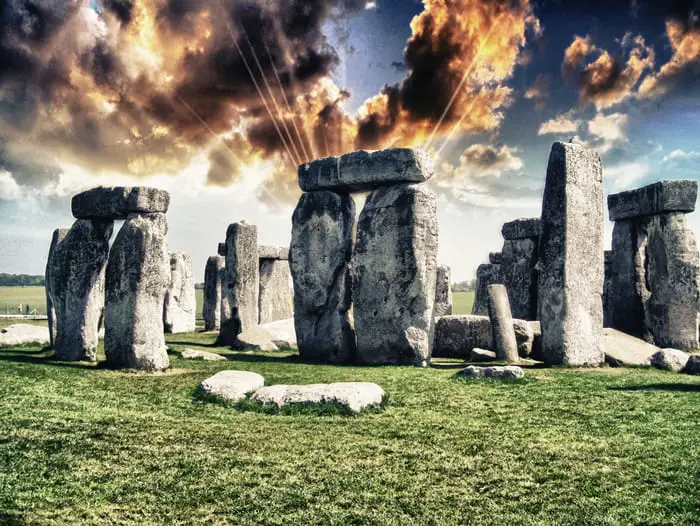
At a distance of around 45 miles west of La Paz Bolivia we find one of the most magnificent ancient sites on the surface of our planet. The sheer number of megalithic stones found at Puma Punku are amongst the largest found on the planet. Puma Punku shatters all traditional views on ancient cultures. The incredibly precise stones, precision cuts, and polished surfaces have defied explanation for centuries. The andesite stones used in the construction process of this megalithic site were cut with such precision that they fit together perfectly, and are interlocked with each other without the use of mortar. This ancient site continues to defy the countless theories put forth by mainstream scholars, historians, and scientists. Many people argue that this ancient site was not the product of man, but of the gods who came down from heaven, thousands of years ago. Stonehenge—an ancient alien landing pad?
Located outside of Salisbury we find a massive circle composed of stones, ranging in weight between 30 and 60 tons. Believed to have been built during the Neolithic, this fascinating ancient site inspired great authors like Erich von Däniken to ponder whether it’s a massive model of our solar system and whether it may have been used as a landing pad for alien spacecraft. Today, modern scholars are still unable to decipher the mystery behind Stonehenge. Experts are unable to figure out how the ancient transported the massive stones, nor why they are positioned like they are. Featured image credit: Leon Tukker. Freelance concept/environment artist and Illustrator. What if I told you that all ancient cultures were somehow connected to each other, thousands of years ago. Have you ever wondered why there are so many similarities among ancient cultures around the globe? Mainstream scholars maintain how cultures in Africa, America, Europe, and Asia weren’t interconnected in ancient times. Despite these claims, numerous archeological discoveries suggest otherwise. Take for example ancient monuments scattered across the globe. Numerous ancient sites in South America show uncanny similarities in design and construction to monuments erected halfway across the world, in Africa for example. Are these similarities a mere coincidence? Or is there a possibility that all of these ancient cultures were interconnected somehow. Is it possible, as some ancient astronaut theorists suggest, that an otherworldly entity influenced ancient civilizations around the globe? How is it possible that the ancient Olmecs, Aztecs, Egyptians, and cultures as those in New Zealand share depictions of their gods—who came down from heaven—which are nearly identical? Is this just another example of random cultural spread? Or is it possible there is more to it than we are willing to accept? Ancient Olmecs and the La Venta Stele 19  ‘La Venta’ stele 19 offers the earliest known representation of the Feathered Serpent in Mesoamerica. The feathered serpent was known across ancient cultures in Mexico as either Kukulkan or Quetzalcoatl. This God is said to have arrived from the heavens, and brought great knowledge to ancient cultures. La Venta is an ancient archaeological site that belonged to the ancient Olmec Civilization. Curiously, the Olmecs were one of the first civilizations to develop in the Americas.  ‘La Venta’ stele 19 offers a curious representation of the feathered serpent: A humanoid figure sitting in some kind of ‘vehicle’ or ‘chair,’ as if manipulating some sort of device. At first, this may not sound extraordinary or weird. However, it becomes strange when you find nearly identical representations of gods, halfway around the world. The Maori legend, and the god Pourangahua  According to the Maori legend, the god Pourangahua flew on his magic ‘bird’ from his legendary dwelling Hawaiki to New Zealand. Curiously, according to legend, this ancient god came from heaven, riding a ‘silver bird.’ In fact, if we take a look at one of the oldest Maori prayers we will find its attribution to the God Pourangahua. “I come, and an unknown earth lies below my feet. I come, and a new heaven turns above me. I come on to this earth, and it is a peaceful resting-place for me. O spirit of the planets! The stranger humbly offers you his heart as nourishment.” If we compare the depiction of the feathered serpent in ancient Mesoamerica folklore to the God Pourangahua, we find a mysterious connection: both are represented nearly identically. How is this possible? A mere coincidence? But there is more… Let’s travel from ancient Maori legends to ancient Egypt.  There, we will find a mysterious representation of the ancient Egyptian God Hapi. Referred to as the “father of the gods,” Hapi was the god of the annual flooding of the Nile in ancient Egyptian religion. This ancient Egyptian God symbolized fertility. This ancient Egyptian god also was usually given blue or green skin, which according to scholars represents the water. Take a look at how he is sometimes depicted. Once again, we have a strange similarity to the feathered serpent in Mesoamerica, and the god Pourangahua, in ancient Maori folklore. Back to Mesoamerica  We venture back to modern-day Mexico where we find another curious representation which has aroused the interest of ancient astronaut theorists: King Pakal. The sarcophagus of king K’inich Janaab’ Pakal or more commonly known as King Pakal is one of the most talked about subjects when it comes to the ancient alien theory. The sarcophagus lid of this great Maya rulers has some pretty curious depictions. Ancient alien theorists propose that it depicts King Pakal in some kind of spaceship during takeoff, and they argue that his hands appear to be manipulating some sort of machinery, his foot is located on a pedal while he is breathing through some sort of breathing apparatus. The theory about Pakal’s spaceship was first proposed by Erich von Däniken in his book Chariots of the Gods. Once again, we see a depiction of a figure inside of some sort of machine. |
||
|
Copyright © 2026 Paranormal News Network - All Rights Reserved Powered by WordPress & Atahualpa 105 queries. 0.131 seconds. |
||