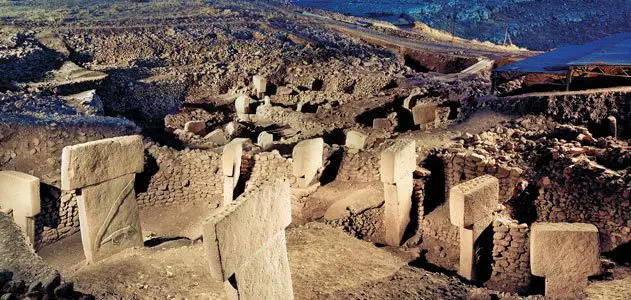
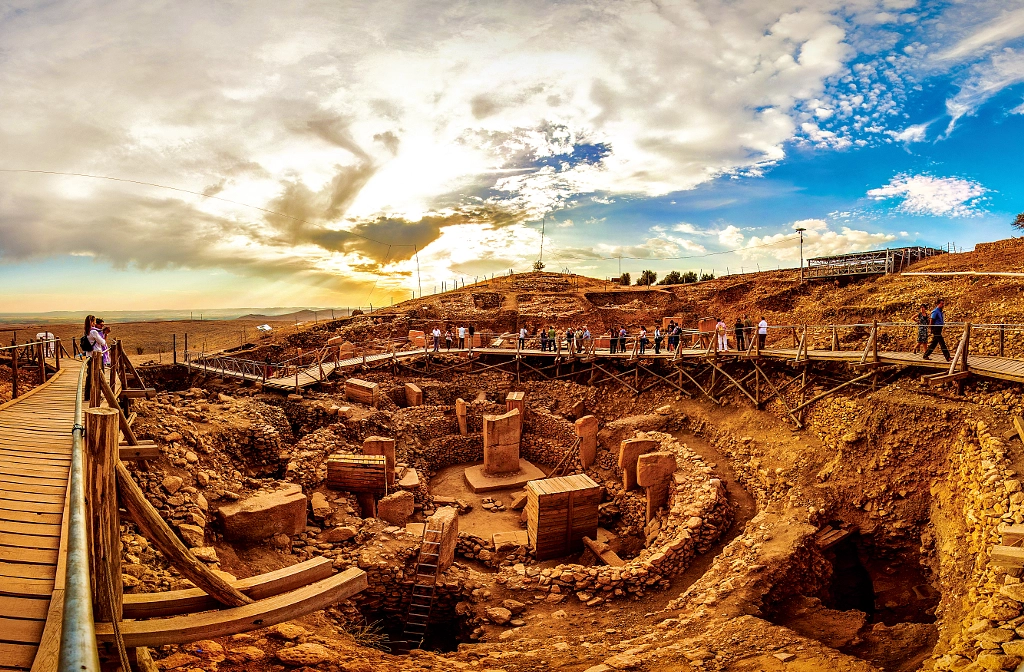
Located 2,500 feet above sea level at the top of a mountain ridge in the Southeastern Anatolia Region of Turkey, some 15 kilometers (9 mi) northeast of the town of Şanlıurfa lie the breathtaking ruins of Göbekli Tepe; a Neolithic sanctuary built some 12,00 years ago by a mysterious people.
This ancient site was found by accident when an old Kurdish shepherd named Savak Yildiz discovered the ruins in October 1994. According got accounts, Savak Yildiz spotted something protruding from the ground, and as he brushed away the dust to expose the mystery object, he came across a large oblong-shaped stone. Little did he know that he had found a long-lost ancient sanctuary built thousands of years ago.
Later that year, news reached archaeologist Klaus Schmidt from the Deutsches Archäologisches Institut who traveled to the location and eventually inspected the site, soon realizing it was Neolithic in origin.
Some called the discovery of Göbekli Tepe as the discovery of the century. Now we know that this ancient site is around 12,000 years old, it was built by an unknown population and was most likely buried on purpose by its builders. Archaeological surveys have shown that the ancient site is around 7,000 years older than Mesopotamia’s Fertile Crescent, which has long been heralded as the cradle of civilization.
The age of Göbekli Tepe is of great importance. Archaeologists firmly believe it is several thousand years older than Stonehenge and The Great Pyramid of Giza.
To get an idea of its importance, if we take a look at biblical tradition, the world began in 4000 BC, yet here we have a monument that was built more than 12,000 years ago. This points not only to the fact that 12,00 years ago advanced civilizations existed on Earth, but they were also capable of erecting some of the most impressive structures on the surface of the planet.
At Göbekli Tepe we have historic evidence that contradicts our normal understanding of the evolution of civilization and therefore mankind as we know it.
However, what is perhaps even more mind-bending is that after more than 20 years of excavations and research, archaeologists exploring the ancient site have failed to recover a single stone-cutting tool.
This makes you wonder, how can you create massive, 19-foot-tall, perfectly-sculpted columns that are up to 12,000 years old, and not find any evidence whatsoever of tools used to accomplish this?
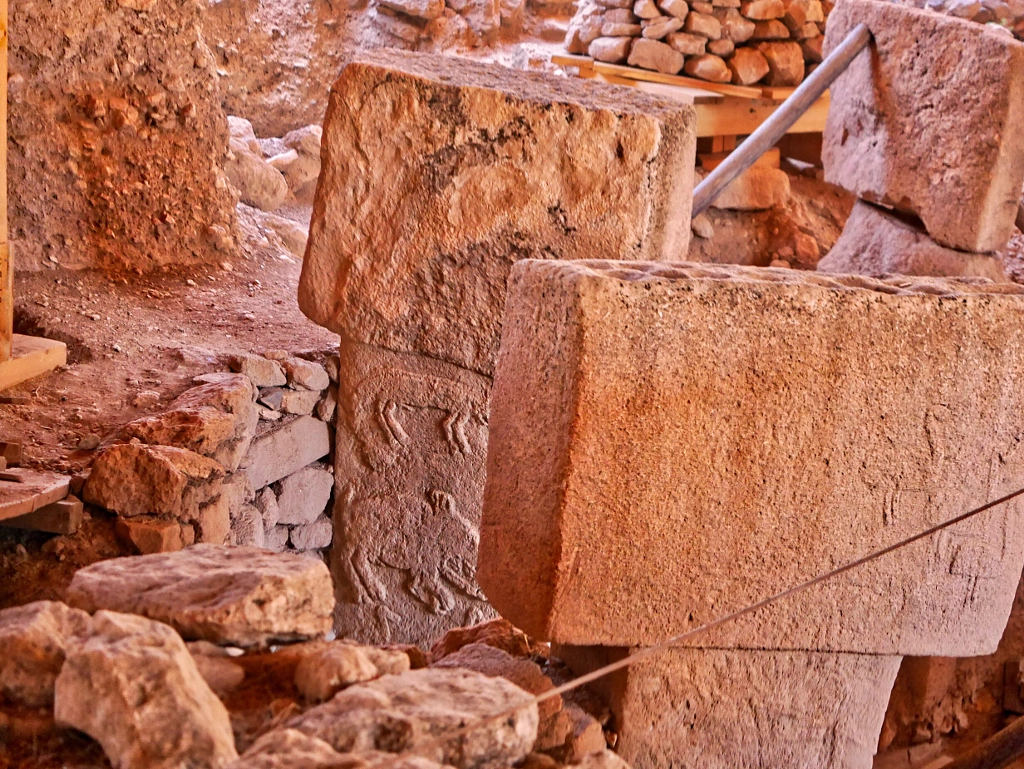
The builders of Göbekli Tepe created a work of art in stone. At the site, we can find depictions of creatures like armadillos, wild boars, and geese, animals that are not indigenous to the region.
What is interesting is that located less than 350 Miles from Göbekli Tepe is the site many biblical scholars believe to be the resting place of Noah’s ark, so the animal carvings of Gobekli Tepe suggest a time in the region’s history when the indigenous animal population may have been of a different anthropological origin. We have to ask the question, could Göbekli Tepe and Noah’s ark be connected in a way?
After decades of exploration, we have learned very little about this archaeological site, and its builders. Despite the fact that progress has been made, we still do not know the answers to some of the most important questions like, who built Göbekli Tepe? To what purpose? And how was Göbekli Tepe preserved until today? Researchers point that Göbekli Tepe was “carefully” placed underneath the sand, as its builders made sure the whole site was buried. But… why would the builders bury such an incredible site? To protect it? To preserve it?
Why would ancient man build these massive structures around the world? Many of them are similar if not identical in design. Is there a connection? A pattern around the globe?
Göbekli Tepe is considered as an archaeological discovery of the exceptional importance since it could deeply change our understanding of a crucial stage in the evolution of human societies. “Göbekli Tepe changes everything,” says Ian Hodder of Stanford University. David Lewis-Williams, professor of archaeology at Witwatersrand University in Johannesburg, says that “Göbekli Tepe is the most important archaeological site in the world.”
At present, Göbekli Tepe raises more questions for archaeology and prehistory than it answers. We do not know how a force large enough to construct, augment, and maintain such an abundant complex was mobilized and rewarded or fed in the conditions of pre-sedentary society.
We cannot “read” the pictograms, and do not know for certain what meaning the animal reliefs had for visitors to the site; the variety of fauna depicted, from lions and bears to birds and insects, makes any single explanation problematic.
Is there something more to Göbekli Tepe? Could these ruins have an extraterrestrial connection? Was Göbekli Tepe built so that the “Sky Gods” could admire it from the sky? Or was Göbekli Tepe built to commemorate an important event in ancient man’s history?
Metasurfaces are two-dimensional (2D), nanoengineered surfaces that interact strongly with electromagnetic waves and can control light with remarkable precision. These ultra-thin layers can be used to develop a wide range of advanced technologies, including optical photonic, sensing and communication systems.
In the right combinations and conditions, two-dimensional materials can host intriguing and potentially valuable quantum phases, like superconductivity and unique forms of magnetism. Why they occur, and how they can be controlled, is of considerable interest among physicists and engineers. Research published in Nature Physics reveals a previously hidden feature that could explain how and why enigmatic quantum phases emerge.
One of the strangest videos showing alleged giants popped up on the internet 11 years ago when in 2007, several new agencies and YouTubers started talking about a video where a massive human is seen standing among the population, somewhere in Japan.
The video claimed to have been filmed in 1890 in Japan quickly made headlines across the world as people started thinking about the possibility that there were giants among us.
Many also started speaking about the Nephilim, the Bible, and legends that suggest how thousands of years ago Giants walked on Earth.
The video raised numerous questions as people cared little for fact checks.
Many claimed it was the ultimate evidence the Bible was right about the Nephilim, and how society in the 21st century was living a lie.
Little did they know that the video was far from any actual evidence of Giants.
Simply put, people love stories about giants, aliens and paranormal things that cannot be easily explained.
Furthermore, by nature people are fascinated by things that we struggle to understand. It’s a mixture of curiosity and fascination.
While there have been numerous reports and even discoveries of supposed massive skeletons, unlike those of ordinary humans, this video footage allegedly filmed in 1890 is not one of them.
While it is surely intricately made and makes you think that someone really filmed a giant walking among people in Japan in 1890, the truth is the video is barely a decade old.
Since the video—and images from the video—popped up on the internet, people started sharing it like crazy, without considering for a moment whether or not it was real.
Dubbed as ‘the ultimate proof’ of Nephilim on Earth, the video spread uncontrollably.
But, someone actually decided to dig deeper and find out more about the video and images.
That, someone, was Dan Evon who researched the mystery Giant video for Snopes.
As Evans wrote in his article for Snopes; “Some people have claimed that the footage comes from the early 1800s (decades before film was invented), while others say that it shows a giant sumo wrestler in a parade. Still, others maintain that the video really shows a Biblical Nephilim giant.”
The truth is that the footage is in fact only 11 years old, and belongs to a scene from the 2007 movie Big Man Japan, a movie which features a wide range of bizarre creatures as Evans explains.
“The “giant,” then, is the product of standard special-effects trickery, not hidden footage that proves beyond a doubt the existence of Nephilim.”
There may be plenty of evidence of Giants existing on Earth, but this one surely isn’t one.
New research shows that dark matter has a different distribution in our galaxy than previously thought, and that advances dark matter’s status as a potential source of the observed gamma ray excess in the Milky Way’s center. High-resolution simulations reveal that the dark matter distribution in the inner galaxy is not spherical, but flattened and asymmetrical. The findings confirm the theory that the gamma ray excess is due to dark matter annihilation.
The simulation of strongly interacting many-body systems is a key objective of quantum physics research, as it can help to test the predictions of physics theories and yield new valuable insight. Researchers at Quantinuum, a quantum computing company, recently simulated a simplified version of a well-known theoretical model, the so-called Sachdev-Ye-Kitaev (SYK) model, using a trapped-ion quantum computer and a previously introduced randomized quantum algorithm.
The ring that inspired Tolkien in writing the trilogy of ‘The Lord of the Rings’ and ‘The Hobbit’, exists and has behind its steps a mysterious story full of curses dating from Roman times.
https://www.youtube.com/watch?v=LwJQnI-LVMo
During the Rule of the Roman Empire over Britain, elite citizens of the time flaunted their status by wearing peculiar rings.
Now, after looking at a set of Brancaster rings, which scientists have dated to the fourth and fifth centuries, researchers have found numerous clues about their owners, who lived during the last days of Roman rule over Britain.
As noted by the University of Newcastle, a Brancaster ring is a type of signet ring with a characteristic square or rectangular bezel, inscribed with characters or text. The rings are named after the Roman Fort and Norfolk village where the first example was discovered in the mid-19th century.
My Precious: This is the ancient gold ring, believed to have inspired JRR Tolkien Image Credit: National Trust/PA
Experts discovered that the metal used in their construction, just as the images imprinted on them give off numerous details about their owners, who were members of high society in Britain.
One of the rings, in particular, the cursed Silvianus Ring is believed to have been the source and inspired J.R.R. Tolkien as he was writing the Hobbit and The Lord of the Rings trilogy.
The so-called Silvanius ring was discovered near Silchester, in Hampshire, England, in 1785. The Ring belonged to a member of a Roman high society called Silvianus but was stolen by a person named Senicianus, upon whom Silvianus called down a curse: ‘To the god Nodens: Silvianus has lost his ring and promises half its value to Nodens. Among those named Senecianus, let none enjoy health until he brings it back to the temple of Nodens.’
In a recent archaeological mission, experts from the universities of Oxford and Newcastle have gathered 54 rings that exist in the United Kingdom and cataloged them all for the first time. Most of the 54 rings were made from silver and only a small number of gold.
Image Credit: Portable Antiquities Scheme
In addition to being used as jewelry, the rings were used in ancient times with wax to seal letters and other important documents.
The various rings are unique, mostly made of precious metal and engraved with different designs. Some bare the symbol of soldiers, lovers, and even emperors.
However, some rings feature evidence of incredible Roman Art, as experts have discovered that some rings have intricate designs such as dolphins and mythical sea creatures, as well as sea griffins which have been found frequently in Roman Art.
Speaking about the Rings, Dr. James Gerrard, senior lecturer in Roman archaeology at Newcastle, said: ‘The fifth century was a period of major upheaval and marked the start of the transition from Roman Empire to Anglo Saxon Britain. These rings and their inscriptions provide a glimpse of what Britain was like during these years and give an insight into the dress, beliefs, ideologies and education level of the elite at the time.
The 2023 law states that groups who steal more than $5,000 worth of goods over a 90-day period are guilty of a felony punishable by at least five years in prison
Archon or Archons were referred to in antiquity as the servants of the Demiurge, the creator god Standing between the human race and a transcendent God that could only be reached through knowledge of humanity’s real nature as divine, leading to the deliverance of the divine spark within humanity from the constraints of earthly existence.
Archon is also Greek word meaning “ruler,” which was also often used in ancient times as the title of a certain public office in a government.
If we take a look at Archons from a Gnostic point of view, we will understand that in this context, they were considered the angels and demons of the old testament.
Hypostasis of the Archons—the divine creators of the universe and humanity
The rulers laid plans and said, “Come, let us create a man that will be soil from the earth.” They modeled their creature as one wholly of the earth. Now the rulers […] body […] they have […] female […] is […] with the face of a beast. They had taken some soil from the earth and modeled their man after their body and after the image of God that had appeared to them in the waters. They said, “Come, let us lay hold of it by means of the form that we have modeled, so that it may see its male counterpart […], and we may seize it with the form that we have modeled” – not understanding the force of God, because of their powerlessness. And he breathed into his face, and the man came to have a soul (and remained) upon the ground many days. But they could not make him arise because of their powerlessness. Like storm winds, they persisted (in blowing), that they might try to capture that image, which had appeared to them in the waters. And they did not know the identity of its power. (Source)
Also called The Reality of the Rulers, the Hypothesis of Archons is an exegesis—a critical interpretation of a religious text—on the Book of Genesis 1–6 and expresses Gnostic mythology of the divine creators of the cosmos and humanity.
Image Credit: Klaus Wittman. Posted with permission.
The Book of Genesis is the first book of the Hebrew Bible (the Tanakh) and the Christian Old Testament.
This ancient text was revered among many other from the Nag Hammadi Library. The Nag Hammadi library also called the “Chenoboskion Manuscripts,” or the “Gnostic Gospels” is a collection of a number of ancient Christian and Gnostic Texts found in Upper Egypt in 1945.
The Reality of the Rulers is believed to have been written sometime during the third century CE. Researchers believe it originated from a traditional period in Gnosticism when it was converting from a purely mythological state into a philosophical phase.
The writing is presented as an instruction on the theme of the dominators (archons) of the world mentioned by St. Paul.
The express intention of this writing is to teach the truth about the powers that have authority over this world.
The story begins with the boast of the demiurge, the supreme archon, in words attributed to the God of the Bible: “I am who I am, God is nothing separated from me.”
The Reality of the Rulers is presented as a learned treatise where a teacher approaches a topic suggested by the dedicatee of the work. The treatise starts off with a fragment of cosmogony, which guides to a revisionistic “true history” of the events in the Genesis creation story, revealing a Gnostic distrust of the material world and the demiurge that conceived it. An “angelic revelation dialogue” emerges within this narrative where an angel repeats and elaborates the author’s fragment of cosmogonic myth in much broader scope, concluding with a historical prophecy of the coming of the savior and the end of days.
Bentley Layton, Professor of Religious Studies (Ancient Christianity) and Professor of Near Eastern Languages and Civilizations (Coptic) at Yale University writes, “The Reality of the Rulers (‘Hypostasis of the Archons’) recounts the gnostic story from the creation of Yaldabaoth down to Noah and the great flood and finalizes with a prediction of the final advent of the savior, the destruction of demonic powers, and the victory of the Gnostics.
As noted by Roger A. Bullard in his book “The Hypostasis of the Archons: The Coptic Text with Translation and Commentary“, the beginning and conclusion to the text are Christian Gnostic, but the remaining of the material is a mythological account about the origin and nature of the archontic powers peopling the skies between Earth and the Ogdoad, and how these ancient events influence the destiny of man.
Although not related at this point, is it possible that the so-called Archons were somehow connected to the Ancient Anunnaki? Food for thought.
According to the Hypostasis of the Archons, these are the Mythic characters:
The Parent of the Entirety: The invisible virgin spirit
Incorruptibility
The Child: Presides over the entirety
The Four Luminaries: Eleleth and three others
The True Human Being
The Undominated Race
Wisdom: Sophia or Pistis Sophia
Zoe (Life): daughter of Sophia
Yaldabaoth: The chief ruler also called Sakla and Samael
Sabaoth: One of Yaldabaoth’s first seven offspring
Adam: The first human being
Eve: Adam’s wife and counterpart
Cain: Eve’s son begotten by the rulers
Abel: Eve’s son begotten by Adam
Seth: a son through god
Norea: Eve’s daughter
Featured image credit: Used with Permission from Klaus Wittmann Concept art.
When the James Webb Space Telescope (JWST) began operations, one of its earliest surveys was of galaxies that existed during the very early universe. In December 2022, these observations revealed multiple objects that appeared as “little red dots” (LRDs), fueling speculation as to what they might be. While the current consensus is that these objects are compact, early galaxies, there is still debate over their composition and what makes them so red. On the one hand, there is the “stellar-only” hypothesis, which states that LRDs are red because they are packed with stars and dust.
After Christmas dinner in 2021, our family was glued to the television, watching the nail-biting launch of NASA’s US$10 billion (AU$15 billion) James Webb Space Telescope. There had not been such a leap forward in telescope technology since Hubble was launched in 1990.
Autonomy algorithms developed by researchers at the University of Toronto Institute for Aerospace Studies (UTIAS) could one day make cargo transport on the moon safer and more efficient for astronauts.
Despite the fact that the discovery sounds like an excellent beginning for a new Indiana Jones Movie—We love Indy—researchers say they have found what they are calling “The Gates of Hell.”
Obviously not in a literal way, this mythical portal to the underworld was mentioned by ancient Greeks and Romans alike.
“This space is full of a vapor so misty and dense that one can scarcely see the ground. Any animal that passes inside meets instant death. I threw in sparrows and they immediately breathed their last and fell,” wrote Greek historian Strabo (64 BCE – 24 CE).
An inscription at the site to underworld gods Pluto and Kore. Image Credit: Francesco D’Andria/University of Salento
The site discovered by experts is located in the ancient Phrygian city of Hierapolis, now Pamukkale in southwestern Turkey
The great majority of ancient legends refer to the different ways of reaching the underworld, going through different stages that increase the suffering of the soul that leaves the body.
For many Romans, this process began in “the gateway to the underworld” and scientists have recently revealed that the site still exists.
The place is actually a cave that has been rediscovered by researchers from the University of Salento (Italy). The place belonged to ancient Phrygia and was used to perform animal sacrifices by priests.
The site as it looks today. Image Credit: Francesco D’Andria/University of Salento.
However, what the ancients considered a reality as a portal to the underworld is something entirely different, and we can thank science.
After finding the location of the ancient ‘portal to the underworld’ scientists have found out why animals that approached the site died nearly instantly.
The cause is an underground seismic activity, through which a large amount of volcanic carbon dioxide is expelled to the surface that killed the animals, but not to the priests performing the sacrifice.
The ancient priests must have surely thought they were favored by their gods, while in fact, it was just science, all along.
Specialists from the University of Duisburg-Essen, in Germany, took samples of the levels of carbon dioxide in the area surrounding the cave and found that the gas forms a kind of “lake” that rises 40 centimeters above the ground.
Deadly Gases Still Emerge From This Ancient Portal to the Underworld. Image Credit: Flickr
One of the most surprising facts is that this area continues to be as deadly as it was back in the days of the Ancient Romans and Greeks.
The gas is dissipated by the sun during the day but is more deadly at dawn. The concentration reaches above 50 percent at the very bottom of the lake, rising to around 35 percent at 10 centimeters, which could even kill a human – but, above 40 centimeters, the concentration drops rapidly, reports Science Alert.
However, above 40 centimeters, the concentration decreases rapidly.
“While the bull was standing within the gas lake with its mouth and nostrils at a height between 60 and 90 cm, the large grown priests (galli) always stood upright within the lake caring that their nose and mouth were way above the toxic level of the Hadean breath of death,” the team wrote in their paper.
“It is reported that they sometimes used stones to be larger.”
Archaeological evidence suggests that the site was fully functional until the 4th century AD, but remained a place of sporadic visitation by visitors for the next two centuries. The temple was destroyed in the 6th century AD by Christians, while later earthquakes may have further damaged the site