Did Google Earth—Moon—just expose an alien structure on the Moon?
According to UFO hunters and conspiracy theorists, there’s a bizarre pyramid structure located on the Moons surface, and it may be the ultimate evidence of alien structures on the lunar surface.
For decades have humans speculated that we may not be the only species in the universe. This idea has become quite popular lately as millions of people around the world seemed to be more convinced than ever that humans have been visited for decades by beings, not from Earth. Some even claim that those interstellar visitors have even visited the moon, where they built extremely advanced alien bases.
Now, a new YouTube video allegedly shows evidence of alien structures on the lunar surface.
Some authors and UFO hunters went as far as stating that the odd formation may be evidence of advanced ancient alien civilizations building structures on the moon before written history.
The oddly shaped lunar formation was spotted by Argentinian UFO hunter Marcelo Irazusta as he scoured Google Earth’s moon viewing software trying to find something out of place.
Little did he know that he would actually find something that does indeed look out of place.
According to Irazusta—one of the many UFO hunters who go through Google Satellite Images in search of alien proof—there’s a structure on the Moon’s surface that is massive: it stretches around two hundred meters into space.
Irazusta, who uploaded his discovery via video on YouTube believes the odd lunar formation is not the result of nature.
People who rushed to view his video seemed to agree with him, as countless commentators called out NASA for covering up alien life and alien structures on the Moon.
Obviously, as all alien related videos, skeptics jumped on board and gave their opinion about the odd structure saying that it’s not a pyramid, it is not evidence of aliens, it’s just a rendering issue.
For those who want to check out the alleged Pyramid by themselves, the coordinates to find the structure on Google Moon are 20°48’45.54″N 25°59’50.89″ W.
And while many still believe that the discovery made by Irazusta is another important piece of evidence of alien structures, the truth is that although interesting, the video itself doesn’t prove anything at all.
For all we know, the alleged structure may just be a natural formation like a hill, or, as skeptics have suggested, just a mistake in the rendering process.
Having that said, that doesn’t mean there aren’t strange things on the moon.
As I have written about in the past, a number of strange discovers have been made on the moon.
Furthermore, as I explain in the article ‘Earth’s Space Station Moon: Was the Moon Created by Intelligent Design?’, there are countless enigmas that have aroused suspicion among scientists who studied the moon in the past. Robin Brett, a scientist from NASA who once said: “It seems easier to explain the non-existence of the Moon than its existence.”
In 1970, two Russian scientists, Mikhail Vasin, and Alexander Shcherbakov published an article in the Soviet journal Sputnik called “Is the Moon the Creation of Alien Intelligence?”
The theory proposed by the two experts offers arguments that would explain the countless enigmas surrounding the moon and its creation.
Their scientific paper raised numerous questions about the moon and its formation which no other scientist at the time dared to ask. After all, mainstream experts were convinced Earthlings were the only intelligent species in the universe.
Despite the fact that their study received heavy criticism, the two Russian scientists made their point when writing about the moon and its countless mysteries. Read more about it here.
I’ve watched all of the movies from the Jurassic Park series and I just loved them. I mean, the movies have a perfect plot.
Imagine yourself stranded inside an abandoned Jurassic Park where countless Dinos are loose, running around waiting to eat you.
Better yet, imagine yourself in a modern Jurassic Park, and due to a number of failures, the cloned Dinosaurs start running around eating everything in their path.
Thankfully that’s just movies.
However, we could soon see an actual ‘Jurassic Park’ come to life.
Russia is opening a new cloning facility worth around £ 4.5 million ($ 5.9 million) that aims to recover the woolly mammoth and other extinct species that have been erased from the surface of the Earth.
Plans for the “world class” research center in the city of Yakutsk will be revealed by Russian President Vladimir Putin during the 4th East Economic Forum to be held from September 11 to 13 in the city of Vladivostok.
Putin said ahead of this year’s session: ‘Russia has currently ensured the most comfortable conditions for attracting advanced technologies and creating new innovative industries.
Mammoth Trunk from Russia. Image Credit: Siberian Times.
‘The special economic zones are advanced special economic zones of the Far East offer foreign investors tax preferences and a simplified administrative regime with infrastructure being modernized at the government’s expense.’
In addition of planning to bring back woolly mammoths to life, Russian geneticists are willing to study a number of extinct species, such as the woolly rhinoceros and the cave lion, which disappeared thousands of years ago due to a number of different factors.
The cloning labs, some of which will be located underground, deep inside the permafrost soil of Yakutsk, aim to expand the current research of Russian scientists who work closely with a team of South Korean specialists to restore the long-dead mammals.
Yakutsk, the capital of the Republic of Sakha, rich in diamonds is a hot spot for the remains of frozen animals.
In fact, up to 80% of the samples of Pleistocene and Holocene animals with preserved soft tissues discovered in Russia have been unearthed in the region.
As noted by experts, the DNA of ancient animals can be preserved in the frozen ground, known as permafrost, for tens of thousands of years. It is hoped that by extracting DNA from these remains, researchers will better understand the biology behind some of the larger creatures that roam the Earth.
For example, woolly mammoths are thought to have coexisted with the first humans, who hunted the animal to use its bones and fangs in search of tools, shelter, and food.
The animal, which could weigh a maximum of 6000 kg (6 metric tons), disappeared from its continental territory at the end of the Pleistocene era, about 10,000 years ago.
However, it is believed that isolated populations survived on St. Paul Island, in Alaska, until 5,600 years ago and on Wrangel Island, in Russia, until only 4,000 years ago.
According to the latest studies, woolly mammoths were most likely killed off due to a shrinking habitat caused by climate change, as well as excessive hunting.
But since we obviously have a thing for wholly mammoths, several international projects, including a team from Harvard University, are already competing to use preserved mammoth DNA to resurrect the ancient species.
According to the Siberian Times, “the 400 million rouble paleo-genetic scientific centre will aim to study extinct animals from living cells – and to restore such creatures as the woolly mammoth, woolly rhinoceros, cave lion and breeds of long-gone horses.”
After Syracuse Officer James Pastorello learned Rhea Holmes was going to visit her late loved ones at a cemetery, he offered her a ride that led to deeper conversations about life and community
“Officers have said they’ve had kids approach them and ask, ‘Do you remember me? I was paired with you in Shop with a Cop,” Meadville PD Sgt. Nick Mogel said
Ret. K-9 Gunner found over $1 million in drugs and helped the Scranton PD capture three fugitives; K-9 Scout died from a medical emergency just as he was about to start police work with the department
Throughout history, the location of the site where Jesus performed His ‘First Miracle’ has remained shrouded in Mystery.
The Gospel of John tells us that during the ‘Wedding at Cana’ Jesus turned water into wine.
The entrance to the cave. Image Credit: Pen News.
The Gospel tells us that Jesus Christ was invited to a wedding together with His mother and his disciples. During the wedding. Eventually, the wine ran out, and it is at that moment when Jesus delivered a sign of His glory and turned water into wine:
2 On the third day there was a wedding at Cana in Galilee, and the mother of Jesus was there. 2 Jesus also was invited to the wedding with his disciples. 3 When the wine ran out, the mother of Jesus said to him, “They have no wine.” 4 And Jesus said to her, “Woman, what does this have to do with me? My hour has not yet come.” 5 His mother said to the servants, “Do whatever he tells you.”
6 Now there were six stone water jars there for the Jewish rites of purification, each holding twenty or thirty gallons.[a]7 Jesus said to the servants, “Fill the jars with water.” And they filled them up to the brim. 8 And he said to them, “Now draw some out and take it to the master of the feast.” So they took it. 9 When the master of the feast tasted the water now become wine, and did not know where it came from (though the servants who had drawn the water knew), the master of the feast called the bridegroom 10 and said to him, “Everyone serves the good wine first, and when people have drunk freely, then the poor wine. But you have kept the good wine until now.” 11 This, the first of his signs, Jesus did at Cana in Galilee, and manifested his glory. And his disciples believed in him.
Pictured here is an archaeologist measuring part of the cave network that is believed to be the ‘real’ site where Jesus turned water into wine during the so-called wedding at Cana. Image Credit: Pen News
The exact location where the first miracle attributed to Jesus took place is a great mystery. Throughout the years the location of Cana has been widely attributed among Biblical Scholars to a number of Villages in Galilee, but no one has ever been able to confirm it.
Thousands of pilgrims were convinced that the exact location of where Jesus performed his first miracle was Kafr Kanna, a town in northern Israel.
Now, a group of researchers says that the location isn’t Kafr Kanna, but a hillside some 10 kilometers further north.
So, what did experts find?
The site experts have identified as Khirbet Wana is a Jewish village that existed between the years 323 BCE and 324 AD. There, experts have uncovered a number of clues that they say suggest it was there where Jesus performed His miracle.
Archaeological excavations have proven the existence of a vast network of underground tunnels used for Christian Worship, where researchers have found crosses and references to Kyrie Iesou, a Greek phrase meaning Lord Jesus.
Experts discovered an altar as well as a shelf containing the remains of a stone vessel. Archaeologists also recovered six stone jars, which are similar to jars described in the Biblical account of the miracle.
The interior of the cave features pieces of water vessels which are believed to be eerily similar to those described in the Biblical accounts. Image Credit: Pen News.
Speaking about the discovery, Dr. Tom McCollough lead archaeologists at the site say that three other sites have credible claims of being the Cana of Biblical accounts.
But, there’s always that but–“But none has the ensemble of evidence that makes such a persuasive case for Khirbet Qana,” he said.
“We have uncovered a large Christian veneration cave complex that was used by Christian pilgrims who came to venerate the water-to-wine miracle. This complex was used beginning in the late fifth or early sixth century and continued to be used by pilgrims into the 12th-century Crusader period.
“The pilgrim texts we have from this period that describe what pilgrims did and saw when they came to Cana of Galilee match very closely what we have exposed as the veneration complex.”
Furthermore, “his references to Cana align geographically with the location of Khirbet Qana and align logically with his movements.”
“The reference to Cana in Josephus, the New Testament and in the rabbinic texts would argue the village was a Jewish village, near the Sea of Galilee and in the region of lower Galilee.”
Running back Oscar Adaway III filed a criminal complaint following a widely viewed incident during a Texas A&M game where a trooper was seen bumping South Carolina players
After questions arose about Mount Vernon Officer Derek Williams’ employment status during prolonged medical leave, the mayor said serious illness “requires a softer touch of government”
King Pakal has been referred to as “the astronaut of Palenque”, mostly because of the engraving that has been found on the slab of his sarcophagus, which many authors claim is the representation of a man inside of a spaceship.
The mask unearthed in Palenque is believed to be the first ever relic found that depicts the mighty ruler, Pakal “El Grande.”
K’inich Janaab Pakal I—commonly referred to as Pacal, or Pacal the Great was ruler of the ancient city-state of Palenque. His name means Shield in classic Maya Language.
He is known for having reigned for a total of 68 years, which is considered the longest reign in the history of America.
The Palace of Palenque. Image Credit: Wikimedia Commons. CC BY-SA 3.0
Pakal’s tomb has been heavily connected to the ancient astronaut hypothesis. In Erich Von Daniken’s 1968 Best Seller Chariots of the Gods, the sarcophagus lid was reproduced by the author who compared the drawing to a man inside a spaceship. More precisely, Von Daniken compared the lid of Pakal’s sarcophagus to depictions of Astronauts inside spacecraft during Project Mercury.
Von Daniken wrote:
“In the center of that frame is a man sitting, bending forward. He has a mask on his nose, he uses his two hands to manipulate some controls, and the heel of his left foot is on a kind of pedal with different adjustments. The rear portion is separated from him; he is sitting on a complicated chair, and outside of this whole frame, you see a little flame like an exhaust…”
Ancient alien theorists propose that the Sarcophagus lid of King Pakal clearly depicts him in some sort of spaceship during takeoff, and they argue that his hands appear to be manipulating some sort of machinery.
Now, experts have made a stunning new discovery.
Archaeologists have recovered a modeled mask which is believed to represent K’inich Janaab Pakal I. The finding was made during conservation works and archaeological studies in the ancient site known as El Palacio, in the archaeological zone of Palenque, in Chiapas, (Mexico). Experts report that in addition to the mask, they’ve also found ritual objects such as ceramic figures, carved bones, and flint.
“It is not a representation of a god. After looking at some images, it’s possible that it is Pakal the Great. We are quite sure of this at this time,” said archaeologist Arnoldo Gonzalez.
“During this process, under the (mask) head there were figurines, ceramic pieces, small plates, a lot of fish bones, which gives insight of a possible relationship with aquatics.”
Furthermore, according to Mexico’s the National Institute of Anthropology and History (INAH), archaeologists have also uncovered the remains of a substructure in the building commonly referred to as Casa C.
The bust of King Pakal was made during the conservation work aimed at addressing the accumulation of water in the east courtyard of the so-called House E, reports INAH.
The discovery is the result of the first stage of a conservation project that the Ministry of Culture of Mexico, through INAH, and with the support of the US Embassy in Mexico, made at the pre-Colombian site.
Researchers have discovered an ancient tomb that has remained untouched for more than 3,500 years in Crete, uncovering the grave of a Minoan man who died around 1,400 BC, when the Island was ruled by a civilization featured in the Minotaur.
In Brief: Archaeologists and archaeology students were called to the scene, where they unearthed an intact, vaulted tomb measuring about 13 feet long, complete with carvings, two skeletons, and about two dozen vases.
The grave was inadvertently discovered by a local resident after he stumbled across an underground cavern sealed in ancient times using clay.
The entrance to the underground tomb.
The tomb and the artifacts are believed to date back to the Bronze age, sometime between 1,200 and 2,400 BCE.
The burial was discovered in an olive grove near the town of Ierapetra, around two and a half meters below the surface and contained a number of funerary possessions such as a cup, a wine-mixing vessel and around fifteen amphorae containers.
According to the Greek Ministry of Culture, the tomb, which was discovered via a vertical channel, was divided into three different chambers.
The interior of the Minoan Tomb.
At the southern end, there was an intact sarcophagus with the lid in place and, inside, the well-preserved skeleton of an adult person “in a very contracted posture,” according to the statement.
The skeletal remains discovered inside the tomb.
In the northernmost end, there was a sarcophagus without a lid and inside it a very deteriorated adult skeleton, in addition to other ceramic vessels.
The Myth
The Minoan civilization arose on the Mediterranean island of Crete sometimes around 2600BCE and flourished for around 12 centuries until around 1400BC.
Evidence of the civilization’s existence was uncovered in 1900 when British archaeologist Sir Arthur Evans unearthed Knossos, the capital of the Minoan Civilization.
The ancient city of Knossos is thought to have been the legendary home of King Minos, who commissioned the ‘labyrinth’ in order to contain the Minotaur, a strange, terrifying creature with the head and tail of a bull and the body of a man.
The Minotaur dwelt at the center of the Labyrinth, which was an elaborate maze-like construction designed by the architect Daedalus and his son Icarus, on the command of King Minos of Crete. The Minotaur was eventually killed by the Athenian hero Theseus.
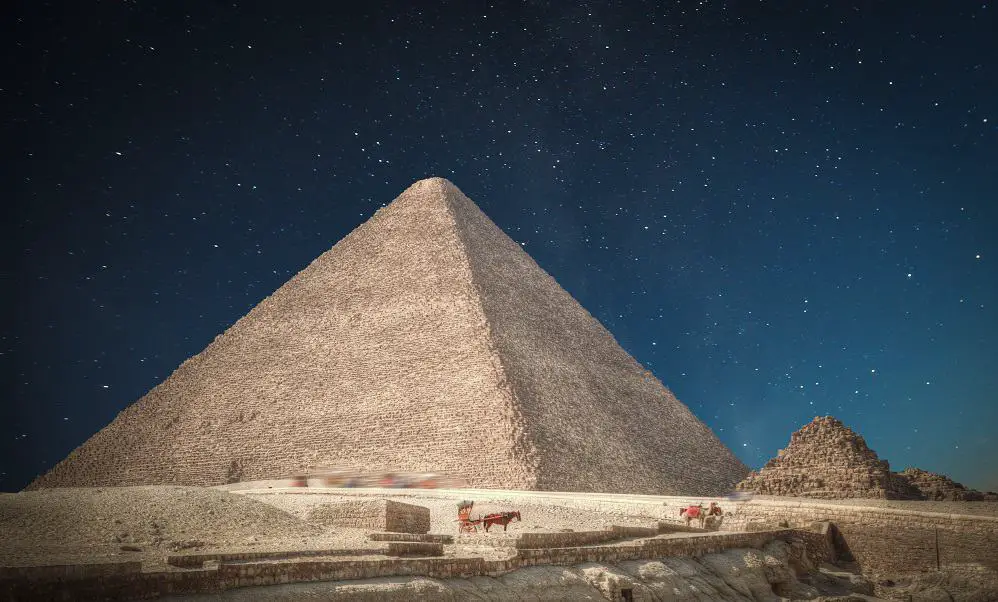
The Great Pyramid of Giza is one of the most astonishing structures ever built on Earth. In addition to being a massive, imposing ancient monument, built using mysterious techniques, the structure located at the Giza Plateau has refused to give up all its secret despite hundreds of years of archaeological studies.
Mainstream scholars maintain that the structure was commissioned by Pharaoh Khufu and that it was built as a tomb over a 10- to 20-year period concluding around 2560 BC.
However, despite massive efforts to prove the Great Pyramid was Built as a tomb, not a single piece of archaeological evidence has been uncovered through the years that would point to the Pyramid being a massive tomb.
Now if the pyramid wasn’t meant to serve as a tomb, what was its true purpose then?
The Great Pyraid of Giza. Image Credit: Shutterstock.
Here are 10 reasons why the Great Pyramid of Giza may have been a massive Energy Machine.
To understand how something like this is even possible, we must take a look at the materials the pyramid was built with, as the construction materials the structure was built with contain unique electrical properties: (1)Authors have found that the granite stones that were used in the Pyramids passageways are slightly radioactive, a feature that allows the stone to electrify the air. For some reason, the builders of the pyramid used (2)Dolomite, a material that is proven to be an excellent conductor of electricity, on the inner surfaces of the Great Pyramid. In addition, Tura Limestone–which happens to be an excellent electrical insulator covers the exterior parts of the Great Pyramid.
In addition to all of that, the Great Pyramid of Giza wasn’t placer randomly on where it sits today. (3)The Pyramid is located on a powerful source of underground energy, like many other ancient structures around the globe. (4)The Geology present at the Giza plateau naturally concentrates high amounts of electromagnetic forces of our planet. Beneath the surface, natural electric forces travel are known as telluric currents or Earth current. Telluric currents are an electric current which moves underground or through the sea. Telluric currents result from both natural causes and human activity, and the discrete currents interact in a complex pattern.
There’s evidence that the Ancient Egyptians used electricity thousands of years ago, despite mainstream scholars refusing to accept this idea. (5)If we take a look inside the Great Pyramid’s Corridors and chambers, there is no evidence whatsoever that the ancient builders of the Pyramid used torches or fire to illuminate the interior of the Pyramid as not a single piece of evidence of neither soot or smoke damage has been found in the corridors.
There are reliefs in different Egyptian Temples that show what many authors interpret as massive lightbulbs. Furthermore, if we take a look at the so-called (6)Baghdad Batteries, we will understand that thousands of years ago, these devices actually produced electricity.
As I have mentioned earlier, (7)there isn’t a single piece of evidence that suggests that the Pyramid was a tomb, and this idea is supported by the interior layout of the Pyramid. The Great Pyramid of Giza greatly differs from all other tombs that have been explored in Ancient Egypt.
The interior of the pyramid is cold in terms of design. (8)There are no decorations inside it, different construction materials were used, and not a single mummy has ever been found in its interior.
Latest scientific research has found that (9)the Great Pyramid of Giza focuses electromagnetic energy. This discovery changed everything we know about the Pyramid. The discovery was made by a team of German and Russian researchers who have proved that the Great Pyramid of Giza focuses electromagnetic energy in its chambers and (10)concentrates the electromagnetic energy in its lower part, located beneath the surface. The researchers took an interest in how the Great Pyramid of Giza would interact with electromagnetic waves of a proportional or, in other words, a resonant length.
Now, why would a ‘tomb’ concentrate and focus electromagnetic energy?