In 2007, paleoanthropologist and rock art researcher Genevieve von Petzinger decided to set out to study geometric signs found in caves and other sites, dating back as far as 40,000 years ago during the Stone Age. While most people are familiar with the familiar petroglyphs of animals, little was known about the symbols alongside them, even though there are far more of them. After traveling across the globe, Von Petzinger was able to document a group of symbols that appear in sites all over the planet. Her findings suggest a common early communication system dating back much further than the first written languages of Ancient Sumer 3,000 years ago.
“The funny thing is that at most sites the geometric signs far outnumber the animal and human images,” said Genevieve von Petzinger. “But when I started on this back in 2007, there wasn’t even a definitive list of how many different shapes there was; nor was there a strong sense of whether the same ones appeared across space or time.”
The paleoanthropologist set out to compile a database of all the known geometric signs at rock art sites in Ice Age Europe. She found that there was vague information on some of the locations and that some hadn’t been studied in half a century or more. She and her husband, Dillon, decided to target the lesser-studied sites across France, Spain, Portugal, and Sciliy. They found a treasure trove of new geometric signs.
“We found new undocumented geometric signs at 75 percent of the sites we visited,” she explained.
The couple ventured deep into cave systems and found symbols on walls a mile into the earth in some cases. Later, she traveled to other sites, including in North America. Armed with a growing database of symbols, the researchers started to see some stunning similarities.
“Barring a handful out outliers, there are only 32 geometric signs. Only 32 signs across a 30,000-year time span and the entire continent of Europe. That is a very small number,” she explained. “Now if these were random doodles or decorations, we would expect to see a lot more variation, but instead what we find are the same signs repeating across both space and time.”
A proto-writing system that may have developed in Africa and then spread throughout the world via Twitter
The researchers found that 65 percent of the signs stayed in use over the course of thousands of years. Some signs appeared to be locally used without wide distribution, while some were used across the world, all the way to Indonesia and Australia. They seem to have agreed-upon culturally-recognized meanings.
“It’s starting to seem increasingly likely that this invention actually traces back to a common point of origin in Africa,” said Von Petzinger.
The geometric shapes aren’t like a written representation of a spoken language but are stylized abstract representations of things people saw in the world around them.
“If we’re talking about geometric shapes, with specific culturally-recognized, agreed-upon meanings, then we could very well be looking at one of the oldest systems of graphic communication in the world,” said Von Petzinger.
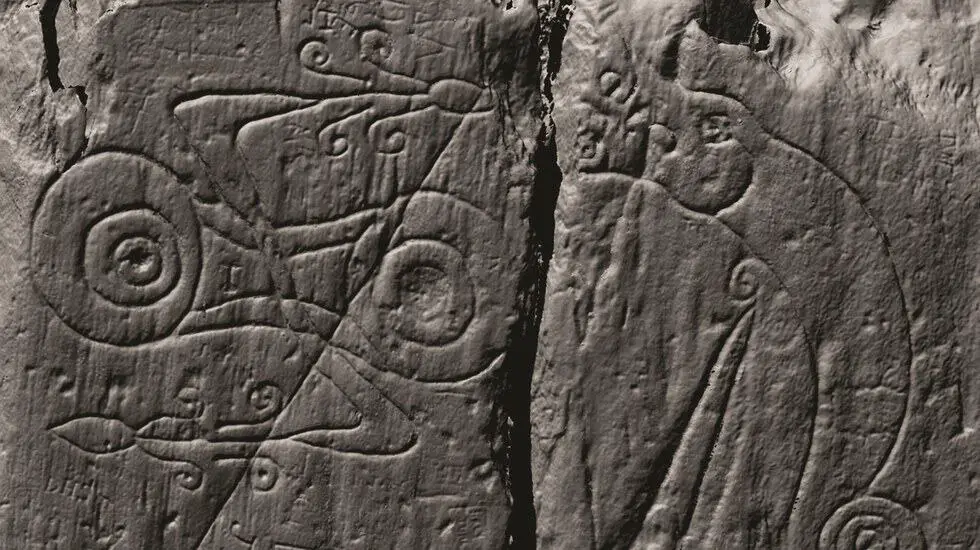
Symbols discovered by Genevieve von Petzinger
These early representations may be the first inspirations for what later developed into abstracted written language. She thinks of them as similar to emojis today.? ? ? ?
“If you think about it, these [geometric signs] are like the great, great, great grandparents of emojis; simple little characters with huge amounts of information embedded into them,” she said. “But you need to be part of the culture group to be able to decipher it. You have to know the code.”
Now that the researchers have found the common symbols, they are working translate what they mean. Objects like a 16,000-year-old necklace from a burial site in France may serve as a helpful decoder. In this case, the necklace is covered with 45 different signs. (see below)
Genevieve von Petzinger with ancient necklace via YouTube
You can find out more in the book “The First Signs: Unlocking the Mysteries of the World’s Oldest Symbols,” by Genevieve von Petzinger.
It’s fascinating to know that ancient geometric symbols appear around the world dating back 40,000 years, though some experts point out that ancient humans created symbolic markings as far back as 500,000 years ago.
When quantum particles work together, they can produce signals far stronger than any one particle could generate alone. This collective phenomenon, called superradiance, is a powerful example of cooperation at the quantum level. Until now, superradiance was mostly known for making quantum systems lose their energy too quickly, posing challenges for quantum technologies.
Formed as a result of the natural processes that created quarries and other natural phenomena millions of years ago underground, the city of Paris and its catacombs are famed for many reasons. Probably one of the most macabre is that it contains about 150 miles of quarries under its streets, complete with the bones of over six million people buried in them. Lauded as one of the most infamous tourist sites in the country, the catacombs are a complex maze that has a rich, if not dark, history.
What began as a new promise of wealth and big city life resulted in massive overcrowding in the 1700s. This overcrowding naturally led to disease and death, and Paris’ cemeteries weren’t big enough to contain all of the bodies that resulted. With the city’s cemeteries full to the brink and the smell of rotting bodies killing the local economy, along with morale and trade, the city closed the Les Innocents Cemetery in 1780; said to be the biggest at the time in France.
Image by Theodor Josef Hubert Hoffbauer/Jebulon via Wikimedia Commons/Public Domain
“By May 1780, the cemetery was literally bursting at the seams. A cellar wall of a property bordering Les Innocents split open under the pressure of excess burials and spring rains, causing a gush of half-decomposed bodies and disease to flood into the basement.”
After closing the quarries due to multiple instances of the Parisian streets collapsing as a result of the massive digging that was mostly unregulated, they were dedicated on April 7, 1786, as a consecrated site for a final resting place for the overcrowded cemeteries, also closed. Between 1787 and 1814, Parisians worked day and night to carry the bones from the closed cemeteries to the quarries, called an ossuary. It was opened to the public even before the transfer was complete in 1809.
Ultimately, the last bones from other cemeteries, in addition to Saint-Eustache and Saint Etienne-de-Grès, were finally placed into the catacombs by 1814, and others the final bones placed about 1860.
Sadly, because the work was dangerous and quite horrible, only poorer Parisians would accept the work. According to a report, they could only move older, decomposed bodies and any skeleton that they unearthed that still contained human flesh had to be burned to the bone. Additionally, some parts of Les Innocents were “left untouched because some mass graves were too recent for their bodies to be exhumed.”
Because the initial deposit of bones was haphazard, simply thrown into piles, Inspector Héricart De Thury ordered that workers rearrange them, an order that ultimately resulted in today’s arrangement.
Tourists can visit the catacombs to this day but are restricted only to specific areas that cover about a mile of the tunnels because visiting the other areas was rendered illegal since 1955. This was largely because many people have gotten lost and, as a result, died in the tunnels, not to mention the very hazardous nature of the underground structures.
One story in particular notes that three teens had to be rescued because they got lost for three days. Another is a bit creepier, as a few cataphiles (what illegal catacomb explorers are called) found a camcorder of an unnamed man who apparently got lost as well. Said to be a seasoned cataphile, he allegedly got disoriented, panicked and dropped the camera, only to run off in the darkness. He was allegedly never seen again. The recovered footage was aired in a documentary in the 2000s (view it below).
Over the years, many people have gotten lost and were never seen again. Also, over the years, many people have gotten lost and made it out alive. You can find many such videos of their adventures on YouTube.
Recently, improvements were made to the catacombs, and it was eventually turned over to the Carnavalet Museum – History of Paris in 2002. The museum still controls and takes care of the catacombs today. If you wish to visit the catacombs, you can get more information on the site and on what you’ll need to do to prepare to enter the ossuary. This includes purchasing a ticket. But if you do visit, remember that while being one of the most beautiful sites, it is also a sacred site, and you should venture underground accordingly.
Astronomers from the Aryabhatta Research Institute of Observational Sciences (ARIES) in India and elsewhere have conducted a long-term photometric and spectroscopic study of a young stellar object known as V1180 Cassiopeiae. Results of the study, published December 23 on the arXiv preprint server, unveil the dual nature of this object.
Researchers working on China’s fully superconducting Experimental Advanced Superconducting Tokamak (EAST) have experimentally accessed a theorized “density-free regime” for fusion plasmas, achieving stable operation at densities well beyond conventional limits.
Dark matter is an elusive type of matter that does not emit, absorb or reflect light, interacting very weakly with ordinary matter. These characteristics make it impossible to detect using conventional technologies used by physicists to study matter particles.
Hypervelocity stars have, since the 1920s, been an important tool that allows astronomers to study the properties of the Milky Way galaxy, such as its gravitational potential and the distribution of matter. Now astronomers from China have made a large-volume search for hypervelocity stars by utilizing a special class of stars known for their distinct, regular, predictable pulsation behavior that makes them useful as distance indicators.
Experimental particle physicists working at the MicroBooNE experiment at Fermilab National Accelerator Laboratory have found evidence against the existence of a “sterile” type of neutrino hypothesized to be responsible for previous experiments’ anomalous results, as detailed in a paper published in Nature.
Syracuse Officer John Canestrare and Firefighter/EMT Rick Macheda performed CPR for 10 minutes before a pulse returned, saving the woman outside a burning home
NASA’s Mars Reconnaissance Orbiter recently completed its 60.000th trip around the Red Planet in May, and has been sending back incredible photos and valuable data since it was first launched in 2005.
But it appears that someone may have already landed on Mars, and they left a calling card for the world to see, according to Futurism.com:
“But its on board HiRise high-resolution camera has never seen anything like this before: now it’s spotted a dune in the shape of the Starfleet insignia, from the fictional television show ‘Star Trek.’ Perhaps Captain Kirk got there before Elon Musk did after all.”
Photo via NASA/JPL
What? Could it be? Has someone already boldly gone where no man has gone before? Not exactly:
This probably a coincidence caused by massive windstorms, lava, and other natural forces forming the Martian landscape — because the alternative is that one of those wacky “Star Trek” time travel plots actually happened, which would be awful.
The NASA has discovered a dune in the shape of Starfleet -the famous logo from Star Trek on Mars,the MRO HiRISE camera,said“Enterprising viewers will make the discovery that these features look conspicuously like a famous log,You’d be right, but it’s only a coincidence pic.twitter.com/feZub0IpO0
Ross Beyer, Principal Investigator with the Carl Sagan Center at the SETI Institute, explained the bizarre “Star Trek” figure the Mars Orbiter photographed:
“Long ago, there were large crescent-shaped (barchan) dunes that moved across this area, and at some point, there was an eruption. The lava flowed out over the plain and around the dunes, but not over them. The lava solidified, but these dunes still stuck up like islands.
“Enterprising viewers will make the discovery that these features look conspicuously like a famous logo: and you’d be right, but it’s only a coincidence.”
Despite that coincidence, actor William Shatner, who starred in the groundbreaking TV series, couldn’t resist trolling the “Star Wars” franchise:
“That’s the goal of this, to really get ahead of what’s happening and remove as many surprises as possible,” St. Cloud Police Chief Douglas Goerke stated
“Merry Christmas to the men and women of the NYPD who have delivered such an unprecedented reduction in violent crime this year,” NYPD Commissioner Jessica Tisch stated
Just as there are those who still believe the Earth is flat, there are those who refuse to acknowledge that climate change is real and that it will harm our modern society. But a new study of ancient climate change offers even more proof that we had better prepare for negative effects.
A team of scientists from around the globe participated in a study of Amazonian peoples who lived at the time of the Medieval Climate Anomaly, which occurred from about AD 900 to 1250, and the Little Ice Age, 1450-1850.
The Medieval Climate Anomaly saw a period of warming similar to that of the 20th and 21st centuries, only warming today is much worse and caused by humans. Scientists have offered several theories as to why this past warming occurred, but they all agree that it happened and it certainly made an impact on many different cultures.
The Little Ice Age, on the other hand, was a long period of global cooling that was caused by volcanic eruptions such as Krakatoa in the 13th and 15th centuries.
Both of these periods of global climate change caused mass migrations, disrupted food production and resulted in natural disasters that made some cultures disappear.
“Were we getting a window into that in prehistoric Amazonia? I think so,” University of Utah professor Mitchell Power said. “So it’s kind of a one-two punch: if the climate doesn’t get you, it might be the thousands of bodies that show up that you have to feed because extreme drought forced them out of their homelands.”
The report details migrations and conflict that took place potentially in response to extreme changes in climate. It notes that the demise of mound centers in the Guianas coast around the year 1300 CE, for example, could have occurred because of a prolonged drought that the researchers documented — or the expansion of a culture called the Koriabo “could have been responsible for conflicts leading to the … demise, or at least accelerating a process triggered by climate change.”
“The flexibility, or lack thereof, of these systems explains the decline of some Amazonian societies and not others …” the report says. Societies that collapsed were at the end of periods of growth, accumulation, restructuring and renewal. “Those societies had accumulated rigidities, and were less able to absorb unforeseen disturbances resulting in dramatic transformation.”
Fascinating new study: well before Europeans arrived in the Americas people in the Amazon were significantly impacted by climate change. “Groups w/o social classes + groups that practiced more sustainable farming practices were able to successfully adapt.” https://t.co/aV3RvLazn5pic.twitter.com/beGLuYulPQ
We are seeing the same kind of migrations today due to conflict and climate change, particularly from the Middle East and Africa to Europe and from South and Central America to the United States. As more places become unlivable, migrations will only increase as people seek survival for themselves and their children. Ancient peoples sought the same thing and some cultures were unprepared for the influx of refugees.
Climate change had already put a strain on some cultures. The sudden population boost exacerbated the problem.
Others were more prepared because they had more diverse food supplies that included growing it themselves and gathering it from natural sources.
As our own society relies more and more on agriculture, we are wiping out forests that provide natural sources of food, medicine, and timber that would come in handy during difficult times.
Our world is so interconnected today, however, that it won’t just be a few scattered peoples who suffer, it will be everyone.
“I believe the most important aspect of the research is showing how societies respond differently to climate change depending on several factors like the size of their population, their political organization, and their economy,” lead author of the study, Jonas Gregorio de Souza of the Universitat Pompeu Fabra, Barcelona, Spain said. “We started the research expecting that climate change would have had an impact everywhere in the Amazon, but we realized that some communities were more vulnerable than others. To summarize one of the main ideas of the paper, those pre-Columbian peoples that depended heavily on intense and specialized forms of land use ended up being less capable of adapting to climatic events.”
Why Some Amazonian Societies Survived and Others Perished amid Pre-Columbian Droughts – interview with Jonas Gregorio de Souza, author of new @NatureEcoEvo study https://t.co/aYf1MwJZZZ
Again, we also rely heavily on specialized land use today on a more global scale than ever before, which makes the whole planet vulnerable. And we’re either smart enough to learn from the past and do something to prevent ourselves from suffering the same fate, or we are doomed. It’s that simple.
“Together, we have a better understanding of the long term changes in climate and human activity,” S. Yoshi Maezumi of the University of the West Indies said. “These long-term perspectives on how people responded to past climate variability, including droughts and increased fire activity may help provide insights into human adaptation and vulnerability to modern anthropogenic climate change.”
Scientists overwhelmingly agree that climate change is real and that humans are the cause this time around. Lessons of climate change in the past give us a glimpse into how bad it can be. But, again, the society we have built on this round blue speck in the universe is far too dependent on agriculture and does not manage other resources well at all. It’s all a profit-driven enterprise that is systematically raping the land, and once everything is gone, it’s gone. We are capable of preventing many of the disastrous effects of climate change. We just have to learn from the peoples of the past and listen to scientists.
Prosecutors said two Huntington Park officers had to make a split-second decision when confronting Anthony Lowe, who had just stabbed a stranger and was fleeing

 ? ?
? ?


 Learn more about how climate change affects the ocean: