Thousands of years ago, ancient people around the globe created a number of petroglyphs and cave paintings. Why ancient man depicted strange beings with 5 or 6 fingers, helmets, sandals, and what appear to be space suits is a mystery no one has been able to answer.
Millions of people around the world firmly believe we have been visited by extraterrestrial beings for millennia.
But if such highly advanced beings visited us in the distant past… how did ancient cultures react 2000-3000 years ago? Did ancient man freak out when ‘highly advanced’ spaceships landed on our planet? Or did ancient cultures glorify the visitors, referring to them as gods? Strangely, many ancient civilizations like the Ancient Chinese, Maya, Aztec and Inca, speak of visitors that came from the heavens bringing great knowledge to mankind.
But even before ancient civilizations recorded their legends and spoke of gods that came down to Earth, people were recording what today is interpreted as ‘alien visitations’.
If we take a look at cave art and petroglyphs around the globe, we will notice that in all corners of the planet, ancient man drew on rock all sorts of important events, and in nearly all petroglyphs found to date, there are representations of mysterious and strange beings that do not resemble human beings.
However, what is even more fascinating is that even though these petroglyphs are found scattered across the entire planet, the depictions of the mysterious creatures are eerily similar. This has lead many to believe that ancient mankind that carved and painted the mystery beings must have seen them at one point in history.
Let us go ahead and take a look at some of the most amazing depictions of ancient aliens discovered to date!
The Wandjina cave paintings
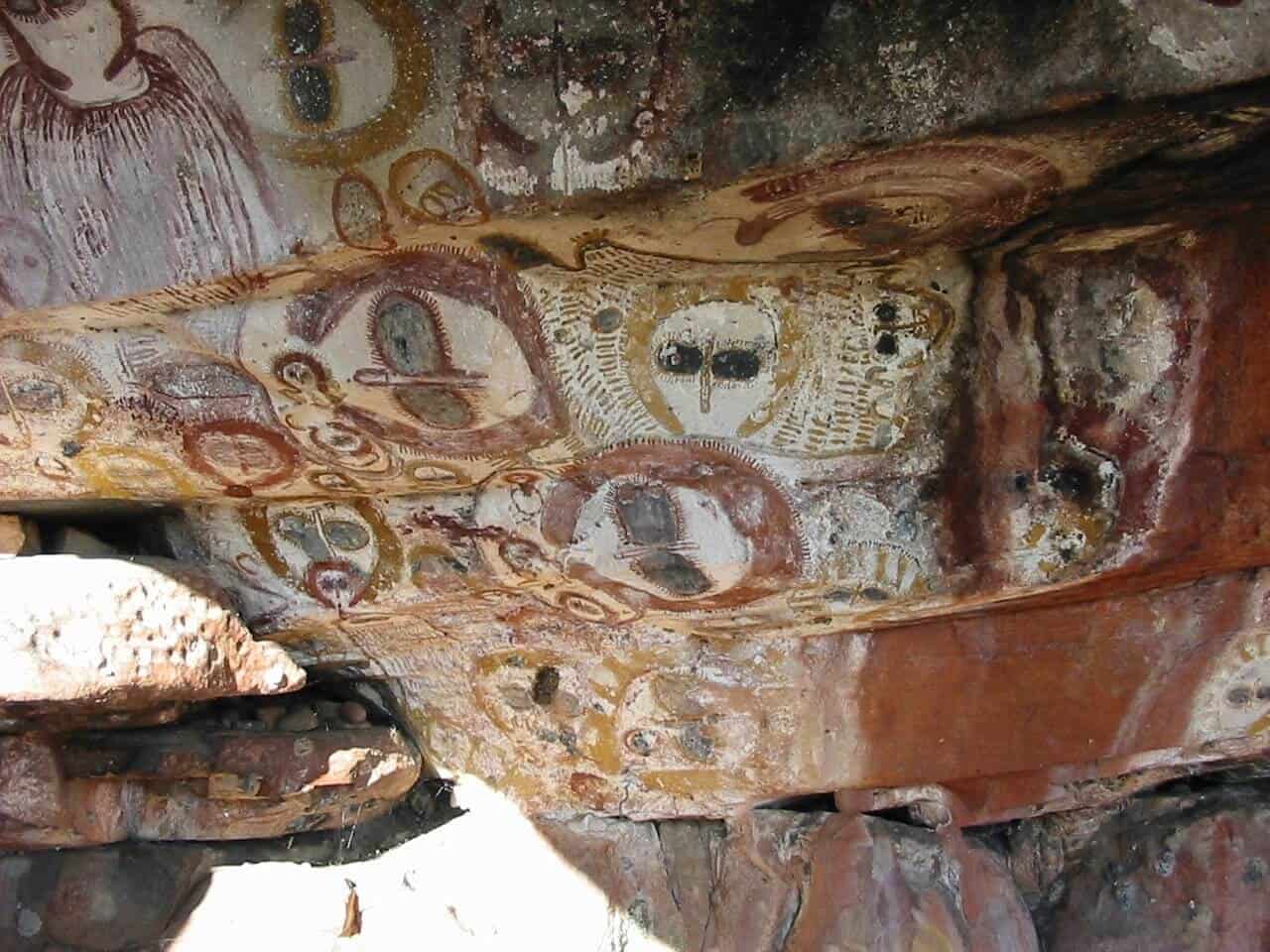
The Wandjina cave paintings are one of our favorite cave paintings discovered to date. There are a number of interesting details about the cave art found in Kimberley, Australia, in 1838. First of all the age of the cave paintings has become a subject of debate among numerous researchers. Some even suggest that the mystery art called the Wandjina could be well over 100,000 years old (yes you read right).
Among the numerous pieces of ‘ancient Picasso art’ ancient people depicted beings that measure up to six meters in height.
Locals refer to the mystery beings as the “wandjinas”. These mysterious beings are said to have brought civilization and prosperity to the people, and like many other ancient cultures around the globe indicate, the enigmatic “wandjinas” also came from the sky. Even more impressive is the fact that numerous ancient cultures around the globe have in their destroy a serpent or dragon. Strangely, the “wandjina’s” symbol was a feathered serpent. Quetzalcoatl anyone?
But even more fascinating are other depiction of the Wandjina, who are depicted as strange humanoid figures without mouths, with huge black eyes and pale white faces that are surrounded by strange halos.These mysterious paintings have received all kinds of interpretation: strange representation of human beings, gigantic owls, down to the theory of Ancient Astronauts, as beings who visited Earth in the distant past.
10,000-year-old cave paintings in India depict ancient aliens
Another fascinating discovery of what could be interpreted as ancient aliens can be found in India where researchers discovered a number of strange pieces of ancient art resembling what many have interpreted as otherworldly beings and disc-shaped objects.
According to Indian experts, it’s as if people, 10.000 years ago made these paintings while looking at science fiction movies.
The set of curious ancient art is located inside caves located near the town of Charama in the Kanker district.
One archaeologist from India firmly believes that this art clearly reflects that 10,000 years ago, people knew we were not alone in the universe.
Archaeologist JR Bhagat made some very interesting comments while speaking about the enigmatic cave art: „The paintings are done in natural colors that have hardly faded despite the years. The strangely carved figures are seen holding weapon-like objects and do not have clear features. Especially, the nose and mouth are missing. In few pictures, they are even shown wearing space suits.“
Tassili n’Ajjer: Proof of Ancient Astronauts?
It seems that there is plenty of evidence of ancient alien visitations.
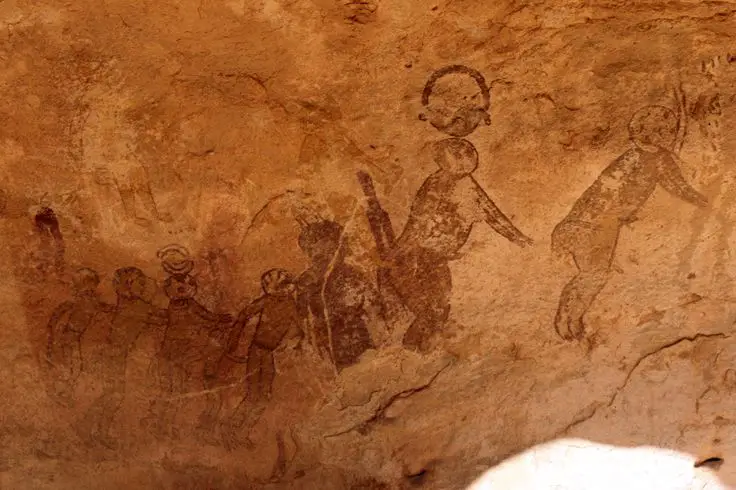
In addition to the above-mentioned cave paintings, ancient art found in Tassili n’Ajjer seems to illustrate mysterious creatures with helmets gloves and strange suits.
Today, experts have managed to catalogue around 5,000 cave paintings in the region. Regrettably, around 20% of them remain visible today, since most of them were destroyed by erosion.
The age of the cave art is believed to be around 10,000 to 15,000 years old. Among the sheer number of rock art found, ancient man drew giraffes, ostriches, elephants, oxen, alligators and even hippos; demonstrating that the Sahara region was full of life in the distant past. However, the most incredible feature are the mysterious depictions of strange beings with helmets and suits, which according to a number of researchers resemble modern-day astronauts.
Why would the ancient inhabitants of Tassili n’Ajjer depict the humanoid figures with helmet-like objects and spacesuits unless they did not seem them? Is it possible, as ancient astronaut theorists suggest, that the natives of the Tassili Caves depicted the ancient astronaut that visited them in the past 10,000 years ago? According to many researchers, it is a possibility.
The Toro Muerto Petroglyphs
Another set of intriguing pieces of ancient art depicting strange beings can be found in Peru at the mysterious Petroglyphs of Toro Muerto, which according to many depict strange humanoid figures that do not resemble human beings.
The petroglyphs cover an area of several kilometers in length. Toro Muerto, which translated, means Dead Bull was named because of the herds of livestock that commonly died because of dehydration in the area.
Among the countless carvings at Toro Muerto, there are interesting depictions of what appear to be, shepherds, hunters, and semi-realistic figures, zoomorphic figures like jaguars, condors, camels, and fish. The ancients also depicted sunflowers and trees without branches, geometric symbols, zig-zags, square, diamond shapes and some inscriptions, intaglios, and bizarre writings all over an area of approximately four kilometers.
The most intriguing depictions at Toro Muerto are those of beings that do not share much resemblance to normal human beings. Even more fascinating is the fact that some of the petroglyphs of Toro Muerto bear a freakish resemblance to petroglyphs found in Australia where ancient man also depicted mysterious beings with ‘halos’ around their heads. The beings depicted at Toro Muerto were carved with a number of strange characteristics, like antennas on top of their heads.
The Petroglyphs at Karahunj, Armenia’s Stonehenge
This ancient site located in modern-day Armenia is fascinating for a number of reasons. First of all, many researchers claim that the site itself predates both Stonehenge in England and the Pyramids of Giza.
This ancient complex occupies over 7 hectares and offers its visitors a number of strange carvings created by early civilizations that inhabited the region thousands of years ago.
Among the numerous carvings, ancient man depicted what appeared to be strange beings with elongated heads and almond-shaped eyes, eerily similar to ‘modern-day’ representations of Grey Aliens.
Featured image: Kimberley – Raft Point paintings – Wandjin by Ian Cochrane via Flickr (CC BY 2.0)
The Island of Sardinia, west of the Italian Peninsula in the Mediterranean Sea, holds many ancient secrets. Today, ancient astronaut theorists are most interested in the monumental tombs and other sites that seem to indicate a race of giants who used advanced technology. If not giants, it’s still unexplainable using conventional historical timelines and conventional thinking.
Evidence of giants includes the so-called “Giants of Mont’e Prama,” 40-50 ancient stone sculptures created by the Nuragic civilization of Sardinia. Some of the ‘giants’ stood over nine feet tall and weighed over 800 pounds, carrying shields and masks. They are said to date before the 8th century BC, which if accurate, means they predate Greek sculptures as the oldest examples of Colossi (giant sculptures) ever found in the Mediterranean.
Megalithic researcher, and explorer, Hugh Newman, shared his video (see below) of these strange oversized sculptures found in Sardinian farmland in March 1974. A farmer made the find while plowing a field when he struck on the stones. Hundreds of thousands of fragments were carefully reassembled to reveal giants and small versions of megalithic towers called nuraghe. These towers gave the Nuragic civilization its name.
Newman also discusses the newspaper account of an eight-foot skeleton unearthed on the island at Porto Torres, supposedly dating to 4,000 years ago. In the next video, he discusses giant-sized bones found by another farmer plowing a field.
Newspaper account and giant tooth via YouTube
Take a look at these bizarre robot-like sculptures from MegalithomaniaUK below.
See the video from MegalithomaniaUK below:
Next, Newman travels to the Giant Tombs, hundreds of collective tombs built by the Nuragic civilization all over the island during the Bronze Age.
The largest tomb is called the Coddu Vecchiu and dates back to 2000 BC. A 100-foot tall carved ‘entrance’ rock that marks the trapezoidal burial chamber behind it. The entrance rock has a smaller semicircular doorway carved out at the base considered “a symbolic passageway for the spirits of the dead.”
The limestone and granite megalithic blocks are enormous, weighing tons and carefully assembled with some stones individually carved into curving shapes.
Take a tour of the Giants’ Tombs from MegalithomaniaUK below:
In the third video, we take a look at the most impressive site of all, the sacred Well of Santa Cristina. The name is misleading, coming from the well’s proximity to a country church dedicated to her in the 1200s.
“The well is composed of an elliptical enclosure surrounding a trapezium-shaped opening in the ground, with stairs leading down to a circular, domed subterranean chamber that housed the spring. The Nuragic religion seems to have involved a lot of symbolic representations of fertility, and included a cult of water that invoked the various feminine aspects of the divine.”
Inside the Giant Tombs and looking out from the Well of Santa Cristina (via YouTube)Walls inside the shrine appear laser-cut (via YouTube)
A round opening in the ceiling allows sun and moonlight to shine down upon the spring, particularly at the equinoxes. Like stone monuments across the globe in Peru and Egypt, the stonework used here is precision-cut and has to be seen to be believed. Inside the shrine, the walls are perfectly smooth, curving, and in some cases use interlocking shapes.
What technology was used? We currently have no idea.
What happened at the shrine? There is no recorded history.
The opening to the shrine forms a perfect trapezium shape while aerial shots of the well show a curving formation, that brings to mind the Hindu Shiva-linga.
While we still have no concrete proof that giants roamed Sardinia, these ancient monuments give us a sense of wonder. How did ancient people create these shrines using enormous boulders cut with near laser perfection? Why do similar finds appear all over Earth when global travel was supposedly impossible at that time? What technology was used? It all remains a mystery that defies traditional ways of thinking.
See the Well of Santa Cristina from MegalithomaniaUK below:
Conspiracy theories are a dime a dozen these days, and most people have at least one they believe in. From the moon being made of cheese and the Twin Towers going down in flames on 9/11 after planes crashed into them to crop circles and more, there are often good reasons why the conspiracies make the rounds as believable theories.
Probably some of the most prevalent conspiracy theories abound about the moon, a topic that’s regained some fuel since the 50th anniversary of the Apollo 11’s landing on the moon recently passed. However, some of the most infamous theories just have bizarre reasonings behind them – here are some of the most prevalent.
The Alien conspiracy theory and random things on the moon
Amid an elaborate NASA coverup, aliens allegedly live on the moon. And Scott C. Waring, self-proclaimed UFO expert and author of the website ET Database, claims to have proof in various photos and videos. He also claims that NASA has since deleted the files proving aliens exist on the moon. He’s made dozens of claims, such as finding alien cities, and wreckage proving alien civilizations lived there some millions of years ago. The most bizarre about this claim that he made in 2013 is that he says the “moon is not real.”
According to the report:
“The evidence that NASA deleted is not just a UFO, but is also 100% evidence that the moon is not real, but actually an alien space station.”
Waring claims that the moon isn’t real because it is instead a huge alien space station disguised to look benign. Just recently, he claimed that he found various structures hidden inside craters that appeared blue and purple in color. However, the images are highly zoomed and processed.
Other random objects supposedly found on the moon includes one found by Richard Hoagland, who claims a photo contained shards of something that “no geological phenomenon” could explain. So it must, of course, be alien in origin. However, this image was also highly processed, and the original photo showed a light spot.
The moon is just a big cheese wheel
It’s more than obvious that the moon is not made of cheese, but this has become a popular myth that’s retold time and time again – and has been for millennia. In fact, one of the earliest known citations of this myth dates back all the way to the 1500s in a book of famous quotes by the author called, “The Proverbs of John Heywood.”
If the moon were made of cheese, we’d know it by now. With the manned moon landing, the umpteen thousands of photographs, video, and images from various satellites – including the Chinese module that landed on the dark side of the moon, we know for sure it’s not made of cheese. Besides, do you really think there are a big cow and a dairy manufacturer “big enough” to make it out in space?
The theory that the moon will turn green (or is green cheese)
This is a variation of the “moon is made of cheese” conspiracy theory. But, as it turns out, the word “greene” was used, which refers to the age of the cheese, and not the color. Recently however a rumor went around that it would turn green – in color. According to the report:
“The planets aligned and caused an eerie glow.”
According to the rumor, the moon was supposed to turn green in 2016 on April 20 and May 29, and it would have been the first time it did so since 1596. But, it didn’t.
A full moon causes us to go crazy
Popular myths related to full moons range from the “it could have a correlation” to the downright bizarre. For example, some people who work in the medical industry say that emergency rooms are busier during full moons, including the increase in birth rates, suicides, and epileptic seizures. Other people believe that crimes are committed at an exponential rate during full moons, or that people just generally become wilder.
There is no statistical data to back up any of the claims, but people tend to believe them anyway.
Supermoons cause natural disasters
In spite of data to the contrary, people tend to believe that more natural disasters happen during supermoons than at any other time. They believe this because of the way supermoons orbit the earth. They orbit closer, which is what makes them appear to be so large on the horizon. As a result, their gravitational pull tends to be stronger – this is what causes the tides to change during this time.
However, there is zero evidence that natural disasters are increased according to all the USGS data compiled on the rumored phenomenon.
The “moon landing never happened” conspiracy
Probably the biggest conspiracy theory of all is that the moon landing was faked. Some people think it was completely staged, and filmed in a closed set. Even former United States military officers believe the landing was faked. Bill Kaysing, a writer for a NASA rocket manufacturer and former U.S. Navy officer, wrote a book about his “inside knowledge of a government conspiracy to fake the moon landings” in 1976. Many of today’s conspiracy theories about the landing come from that book, according to the report.
According to those who believe the conspiracies, some photos show many anomalies in the film that prove the landing was faked. Such as the U.S flag that the astronauts planted flying in the wind when there wasn’t any. Or that there were footprints left (without water) by the astronauts but not by the lunar module itself. Or that there aren’t any stars visible in the photos.
Legitimate conspiracy theory explanations
However, as seemingly legitimate these questions are, there are also legitimate answers. For example, NASA sewed a metal rod into the flag so it would fly that way. And you don’t need water to make footprints because friction can cause the same effect – not to mention that the lunar module had its weight more evenly distributed, so it wouldn’t have left prints as the astronauts did. Oh, and you know how when you stargaze in the middle of the city, but only see a very few? This is because of the “washed out” effect from city lights. This is the same effect the sun had on the stars in the background of the photographs that made it appear there weren’t any.
For all of the theories that abound, the most prevalent are those about the moon landing and aliens. NASA, of course, refutes all the claims, but it makes you wonder why the organization would delete photos or video of anything, especially after someone makes those claims. Could they be hiding something? Or are the collective imaginations of millions just running wild with conspiracy theories?
Using the Anglo-Australian Telescope (AAT), astronomers have observed a nearby galactic globular cluster known as NGC 6569. Results of the observational campaign, published December 22 on the arXiv preprint server, indicate that this galaxy is actively losing stars through tidal stripping.
The disappearance of the Ancient Puebloans, also known as the Anasazi, from Chaco Canyon in the 12th century is an enduring mystery that is still debated to this day, but a Colorado University paleoclimatologist believes he has solved part of the puzzle.
Located in New Mexico within the Four Corners region, Chaco Culture National Historic Park is one of the most stunning pre-Columbian sites in North America.
Great ruins mark the landscape, including the tallest buildings in North America until the 19th century when skyscrapers were born.
At its height, the Chaco Canyon settlement had a population of more than 2,000 people and seemed to prosper. But the Anasazi soon abandoned the civilization they worked so hard to build, leaving researchers with many questions, including why they left the area.
It turns out that question has multiple answers, but the prevailing answer is climate change, which resulted in not enough food to sustain the population.
When the settlement was first built, the climate was suitable for farming and trade routes extending up to 100 miles were established. Unfortunately, as we are experiencing today, the climate can have a drastic effect on civilization.
A series of droughts struck the Chaco Canyon region over the course of 300 years beginning in 1130, around the same time the Ancient Puebloan civilization began to decline.
Retired geochemist and paleoclimatologist Larry Benson, who is also the curator of the Colorado University Museum of Natural History, sought to find out if land in such conditions could sustain enough agriculture to feed the population.
“You have this place in the middle of the San Juan Basin, which is not very habitable,” Benson said.
Together with Ohio State University archaeologist Deanna Grimstead, Benson studied data on rainfall in the region along with flash flooding and discovered that even if the Anasazi tried to grow enough maize to feed everyone, their efforts would fail miserably.
“You can’t do any dryland farming there,” Benson said. “There’s just not enough rain.”
Indeed, and even when enough rain fell, flash flooding would wipe out the crop.
“If you’re lucky enough to have a spring flow that wets the ground ahead of planting, about three-quarters of the time, you’d get a summer flow that destroys your crops,” Benson said.
The Anasazi even failed to plant enough acreage to feed the entire population.
The team calculated that Chacoans could have, at most, farmed just 100 acres of the Chaco Canyon floor. Even if they farmed all of the surrounding side valleys—a monumental feat—they would still have only produced enough corn to feed just over 1,000 people.
The researchers also went one step further, assessing whether past Chaco residents could have supplemented this nutritional shortfall with wild game like deer and rabbits. They calculated that supplying the 185,000 pounds of protein needed by 2,300 people would have quickly cleared all small mammals from the area.
In short, there would have been a lot of hungry mouths in Chaco Canyon.
Benson and his team have reached two possible conclusions about the settlement. The Anasazi people either imported most of their food until supply chains collapsed or the settlement merely served a temporary purpose such as for religious pilgrimages or a shelter during times of conflict.
During those times, people may have simply brought their own supplies to survive until they left.
“Whether people are bringing in maize to feed 2,300 residents, or if several thousand visitors are bringing in their own maize to eat, they’re not obtaining it from Chaco Canyon,” Benson said.
And it’s certainly possible that supply lines collapsed because the Great Drought also resulted in the decline of other great Native American civilizations, such as the Mississippian culture.
And so, the Anasazi abandoned the site and the population scattered in different directions, which is why Puebloan people today object to conclusions that the Anasazi disappeared off the face of the planet.
They say that their ancestors assimilated into other tribes in more habitable areas and passed down stories and traditions from the Chaco Canyon settlement and elsewhere over the generations.
University of Denver professor Dean Saitta agrees.
“The Anasazi were terribly diverse in their ethnic affiliations,” he told the Fort Morgan Times back in 2010.
Saitta says that rather than just mysteriously vanishing, the Anasazi became members of other tribes such as the Hopi, Zuni, and Rio Grande Pueblo. That claim is backed up by the oral histories of the tribes.
Furthermore, Saitta theorizes that emerging religious differences may have contributed to the break up of communities.
“People voted with their feet,” he said.
Regardless of why they left their homes, the Anasazi people certainly left their mark in the American Southwest. Their structures have stood the test of time and continue to awe visitors, many of whom never realized that such strong cultures existed in North America before Europeans established colonies.
The ruins also serve as a warning that no civilization lasts forever, and if we do not take climate change seriously, we could watch our own food supply collapse and be forced to leave our own communities behind just as the Anasazi did hundreds of years ago.
See more about Chaco Canyon and the mysteries of the Anasazi below
The cards feature a photo of the Oviedo officer, a brief profile of their work assignment and a fun fact about themselves, as well as the officer’s personal motto
Crop circles, elaborate patterns found in farmer’s fields, continue to fascinate people worldwide. Although some have been elaborate hoaxes, others remain a mystery, tangible and real yet unexplained. The first simple crop circles started to become a regular phenomenon when they appeared in the southern English countryside in the summers of the 70s. Ever since they seem to have become more and more elaborate. Some people believe the intricate geometric patterns are messages sent from higher intelligence, extraterrestrials, or even time travelers. One Italian inventor, Umberto Baudo, believes crop circles may be meant to impart secrets of new technology and free energy to humanity.
In 1991, a book titled, “Crop Circles: Harbingers of World Change” by Alick Bartholomew was published. It explored the idea that some crop circles could be messages from non-human intelligence from beyond this physical world. Maybe the formations were meant to deliver secrets for new advanced technology. In the book, an English historian and psychic, Isabelle Kingston, suggested that crop circles might reveal a molecular structure or blueprint for a new form of energy that would one day be unraveled by scientists.
It was the same year that two British men came forward to take credit for creating hundreds of crop circles: Doug Bower and Dave Chorley. As more and more crop circles are discovered, the idea that they could be messages from aliens persisted. Crop circles became more and more elaborate, and some believe they can’t all be chalked up to a hoax.
If crop circles are an intended message, then what is it?
In 2008, Umberto Baudo decided to use crop circles as an inspiration, a blueprint for a mechanism that he believed could deliver a source of free energy, similar to the ultimate goals of Nikola Tesla. Baudo’s work, like that of Tesla’s plans for free energy, has remained obscure, but now with a translation from researcher Pedro M. Duarte, we can look at his findings with English captions in the video below.
Baudo recognizes that some crop circles are hoaxes, but among the hundreds of images found, he chose the formations he believes represent authentic energy generating systems. He demonstrates that those formations can operate like the gears of a machine.
“Since 2008 I realized that it is absolutely possible to generate free energy to all of the planet, and instead of having to pay large amounts of money to have in exchange [for] a small amount of energy,” said Baudo.
Umberto Baudo works on a computer simulation showing an “eccentric core”
In Baudo’s first experiments, he attempted to create magnetic motors. The prototypes were arrays of circles based on crop circle formations. His work progressed from magnetic systems to systems using centrifugal force and tested using computer simulations. The simulations allowed him to find out what happens when the shapes are rotated at high speed, generating energy both with and without the variables of gravity and counterweight mechanisms: magnets, springs, and chains.
Baudo believes extraterrestrials chose to communicate with crop circles for a reason.
“It’s important to understand that the Crop Circles are the maximum expression of a message because through an image you can communicate much more than with words without any doubt,” he explains. “…especially if the message [is addressed] to someone that does not speak our language.”
The inventor found that the rotating systems could whirl around an “eccentric core,” shapes he recognizes in many crop circle formations. Spinning around this core, the circular shapes generate momentum.
See Umberto Baudo discuss his experiments with English captions from Pedro M. Duarte below
In the second part (below), Baudo is convinced that crop circles are meant as examples of using centrifugal force and that he has decoded their meaning. With modifications, including the addition of a spring, he says he has created perfect models that continue to build momentum even after the engine is turned off. All thanks to centrifugal force…
“After some years studying and researching, always with these images in my mind, finally I think I’ve found the key to understand the [main] part of these crop circles. The main key to understand it is fundamentally one: The centrifugal force. Just like that!”
Computer simulation showing ever-increasing energy output as the model spins
The circular gears rotate until the spring slowly reaches full extension.
“The speed will increase, always in a constant way, until the spring achieves its maximum. In that moment [it] will stabilize,” he explains.
Although many people remain skeptical, he believes that these systems can work against the first principle of thermodynamics, that states the total energy of an isolated system is constant. Instead, the engine he simulates continues to accelerate, while the “eccentric core” of the disc appears distorted into an oval shape.
In part 3, Umberto Baudo has advanced beyond the computer simulations to create the mechanics of the centrifugal motors in three dimensions. We see his team working to test the pieces cut out of metal, and in the latter part of the video in English, he discusses his findings with a man who puts him in contact with experts in America. From here, we are left to wonder what happened next.
Umberto Baudo works on making 3d versions of his computer simulations
What happened to Umberto Baudo’s designs? If he had been successful, surely we would know about it, right? Yet delivering a source of free energy to the world would most likely be met with incredible resistance in a world where economies revolve around monetized methods of energy delivery. Finding a source of unlimited free energy would change the global economy, freeing people from the need to labor endlessly to pay energy bills.
Will Baudo’s ultimate findings remain a mystery, like crop circles? Like Nikola Tesla’s plans to deliver free energy to the people? Are beings with higher intelligence trying to tip the odds in the common person’s favor, allowing us to finally have such technology distributed to everyone worldwide? Or, are we all overly optimistic to think this is even possible? Are crop circles just elaborate hoaxes by people who want to keep our hopes alive?
While most planets that we are familiar with stick relatively close to their host star in a predictable orbit, some planets seem to have been knocked out of their orbits, floating through space free of any particular gravitational attachments. Astronomers refer to these lonely planets as “free-floating” or “rogue” planets.
Quantum particles have a social life, of a sort. They interact and form relationships with each other, and one of the most important features of a quantum particle is whether it is an introvert—a fermion—or an extrovert—a boson.
When 3I/ATLAS swept past the sun in late October 2025, it became only the third confirmed visitor from interstellar space ever detected. Unlike the mysterious ‘Oumuamua, which revealed almost nothing about itself during its brief flyby in 2017, or even 2I/Borisov which appeared in 2019, this latest interstellar traveler arrived with perfect timing for detailed study.