“Members of the public have been following, yelling at, demanding identification and engaging with [SWAT and Crime Reduction Unit] officers,” Vancouver PD Chief Troy Price said
|
|
||
|
Juan Ponce de Leon is probably best known for discovering what is now known as the U.S. state of Florida, but he’s also associated with a search for the so-called “Fountain of Youth” which would supposedly make one young again if they so much as bathed in or drank from the water. But as with many things that get mythologized over time, it turns out that Ponce de Leon likely never went in search of any such fountain, according to Ancient Origins.  From Page to ExplorerJuan Ponce de Leon was born in 1460 (though some allege the actual year of his birth was 1474) to a poor family in Valladolid, Spain, and served as a page in the court of Aragon. When he matured, Ponce de Leon became a solider, fighting in the Spanish military campaigns against the Emirate of Granada. But once the war ended, his services were no longer needed, so he decided to become an overseas explorer, hoping that he might gain fame and fortune as a result.  Ponce de Leon trained to be an explorer by joining the second expedition of Christopher Columbus to the New World in 1493. As a result of his service with Columbus, Ponce de Leon was named the military commander and later governor of the island of Hispaniola, which is now known as the Dominican Republic. While serving as governor of Hispaniola, Ponce de Leon heard that another island, San Juan Bautista, was loaded with gold, so he obtained permission from the Spanish royal family to go and explore the island. A Spanish settlement was established on San Juan Bautista and once again Ponce de Leon became governor of what later became modern-day Puerto Rico.  The Fountain of Youth?As an explorer, Ponce de Leon was far from the only consquistador looking to make his name in the New World. And some of his rivals actively tried to bring about his downfall:
 As he searched for the tiny island of Bimini, rumors spread that Ponce de Leon was actually seeking the elusive “Fountain of Youth,” but some historical scholars say that was never the the explorer’s intent:
The court chronicler hated Ponce de Leon, so he slurred him as a fool who was motivated by ego and greed:
 Florida Instead of BiminiAs he continued to search for Bimini, Ponce de Leon instead found Florida, which got its name from the fact that Ponce de Leon landed there during the Easter season, which in Spanish is known as Pascua Florida. A year later, Ponce de Leon was given permission to colonize the region of Florida, but during the expedition the explorer was wounded in a thigh by an arrow. That wound later killed him at the age of 61. But despite meeting his end while attempting to secure his place in history, Ponce de Leon gained a bit of immortality, and to this day is one of the most recognizable names of all the famous Spanish explorers, second only to Columbus himself, who was his mentor in the early days of his career. Oddly enough, however, Ponce de Leon is now associated with the fictional “Fountain of Youth” which it appears was little more than an attempt to discredit him. Instead, it has given him the sheen of immortality all these centuries later. Here’s more on the famed explorer: https://www.youtube.com/watch?time_continue=2&v=lmRbNQBQ5OA Featured Image: Madame Tussauds Orlando – Juan Ponce de Leon by Jared via Flickr (CC BY 2.0) with Fountain via Pixabay by Mabel Amber YouTube Video Here: https://www.youtube.com/embed/lGH4MK9O2J0?feature=oembed&enablejsapi=1 For decades, archaeologists have agreed that Homo sapiens were the first to create and use fire some 400,000 years ago, marking a profound turning point in the cultural aspect of human evolution because it provided a source of warmth and protection. But new data from a team of researchers at the University of Connecticut, working in conjunction with colleagues from Armenia, the United Kingdom, and Spain suggests that early humans such as Neanderthals also controlled fire and had mastered the ability to generate it.  A new article from those researchers has just been published in Scientific Reports, and what it suggests could drastically change our overall understanding of early man:
The work of this team from the University of Connecticut includes archaeological, hydrocarbon, and isotope evidence of human interactions with fire, along with what the climate was like on Earth thousands of years ago. Related: Neanderthals used and recycled an ancient glue made using fire to construct tools  For proof of their theory, the team went to Armenia, where they closely examined Lusakert Cave in the highlands of the country. Gideon Hartman, associate professor of anthropology, and study co-author noted that the hope was to better understand the true history of man and fire:
 Looking at sediment samples, the research team was able to determine the abundance of polycyclic aromatic hydrocarbons (PAHs), which are released when organic material is burned:
 But the researchers also had to try and eliminate the possibility that weather may have caused the fires which were showing up in the scientific data they found in and around the Armenian cave. Once they could eliminate that possible explanation, they would be closer to proving that man did indeed begin using fire far ahead of the established timeline. After rigorous testing, a conclusion was reached:
Related: Archaeologists change view that Neanderthals were cave dwellers With that question answered, the team was able to conclude that early humans before Homo sapiens did indeed have the ability to build and control fire, overturning the long-held beliefs that have guided the scientific community for decades. The next step is to look at other caves and see what clues they may contain:
The questions are endless, but they give us even greater insight into our ancient ancestors and how they acquired much of the knowledge that we now take for granted. Related: Evidence of three human species and dangerous animals in one ancient Siberian cave This video on how man tamed fire helps explain this most important step in human evolution Featured Image Via Wikimedia Commons Video shows the woman ignoring Buffalo Police officers’ commands to drop the knife and advancing toward a group of people she knew before stabbing a man in the head
The Mount Pleasant Police Department launched an investigation after receiving a tip and initially fired two officers; another investigation led to the separation of eight more
President Trump calls on lawmakers to pass legislation to end sanctuary policies and judges hear arguments about pausing Operation Metro Surge following Alex Pretti’s death
How crowd dynamics, officer training and real-time decisions shaped the narrative before the investigation began
The San Diego PD body camera footage shows officers issuing multiple commands not to reach for the object; the man reached toward the object before an officer fired two shots
YouTube Video Here: https://www.youtube.com/embed/taungcjOHnk?feature=oembed&enablejsapi=1 Mainstream scientists seem to have inadvertently given some support to the ancient astronaut theory again.Recently, we wrote about a “new” scientific discovery that unlocked the potential of gold atoms, with 2D gold nanosheets. Using layers of gold just two atoms in thickness, the researchers made a “landmark achievement.” The gold nanosheets are ten times more efficient than even nanoparticles as a highly-effective catalyst. This news immediately sounded familiar to those who follow ancient astronaut theory, since gold is central to the story. According to translations of cuneiform tablets from Sumeria, the Anunnaki, giant-sized long-lived extraterrestrial explorers, came to Earth to mine gold hundreds of thousands of years ago. The gold was essential for technology used to repair damage to the Anunnaki home planet’s environment, among other uses. The gold mining operations were taking place in southern Africa and predated the earliest civilizations in Sumer and Mesopotamia by unfathomable thousands of years. An in-depth timeline of events is suggested by Zecharia Sitchin and other ancient astronaut theorists. Today, news that scientists have traced the origins of all humans to southern Africa is again ringing bells for ancient astronaut theorists. According to the Guardian, scientists made eyebrow-raising conclusions using 1,217 samples of mitochondrial DNA from people living in southern Africa.
 According to the article, these early humans then started to spread into other territories as the Earth’s orbit changed. This fact also sounds familiar, as climate changes on Earth were central to Sitchin’s story of what took place some 200,000 years ago. According to the controversial author, life on the planet regressed due to a glacial period and then began to spread as the planet warmed up again after 100,000 years. Related: Scientists trace modern human lineage to Botswana in Africa, disappointing racists everywhere Adam’s CalendarOne landmark offered as evidence of an ancient civilization in southern Africa is called “Adam’s Calendar,” a Stonehenge-like ruin discovered in 2003. The place is known by African elders, as the “The Birthplace of The Sun.” Ancient Origins notes it has been controversially called the “oldest man-made structure in the world.”
Stone ruins similar to this are found throughout the mountains and valleys of southern Africa, including Botswana. Like Stonehenge, Adam’s Calendar has incorporated incredibly complex precise measurements.
 According to ancient astronaut theorist Graham Hancock, other ancient relics discovered in the area point to connections to the later civilization of Egypt.
Below, megalithic researcher and explorer Hugh Newman, who often appears on the Ancient Aliens series, explores Adam’s Calendar. Further east to the coast at Maputo, Mozambique, an ancient city was discovered around 2015. According to South African news, a sprawling city made of dolomite rock could date back to 200,000 years old. Author Michael Tellinger wrote about the city in his book: Temples of the African Gods. Nearby, we find ancient gold mines.
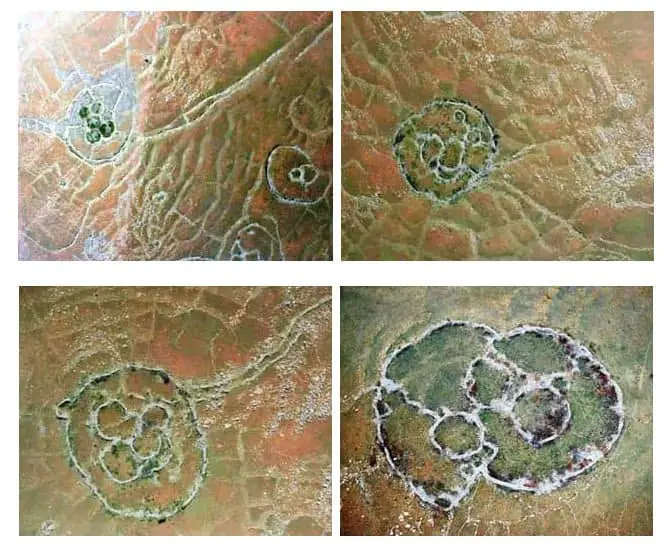 Among the oldest gold mines is Ngwenya Mine in Swaziland. The UNESCO recognized site is “one of the oldest geological formations in the world, and also has the distinction of being the site of the world’s earliest mining activity.” From the UNESCO World Heritage Centre:
So there you have it: Scientists and ancient astronaut theorists seem to have arrived at similar conclusions in this case. Don’t count on seeing it again in the near future, but who knows what could happen next? You can get the full ancient astronaut take in the video on Adam’s Calendar from South African author, politician, and explorer Michael Tellinger below. He refers to it as “Enki’s Calendar,” after the Sumerian deity who began the gold mining empire.  Video featuring Michael Tellinger below: https://www.youtube.com/watch?v=U2b9E-VZZII Featured image: Selection from The Adda Seal, an ancient Akkadian cylinder seal showing (from left to right) Inanna, Utu, Enki, and Isimud (circa 2300 BC) via Wikimedia Commons, public domain with Ngwenya Mines by Heather Dowd via Wikimedia Commons (CC BY-SA 2.0) YouTube Video Here: https://www.youtube.com/embed/U_REwdeweg4?feature=oembed&enablejsapi=1 It’s one of the most well-known stories from the Bible: Noah and his family were instructed by God to build an ark and load it with two of every animal. Noah did as he was instructed and the great flood came, destroying everything except Noah, his family, and the animals on the ark. But did the great flood actually happen, or is the story of Noah just a myth?  The recent discovery in the Black Sea of a ancient ship graveyard may finally provide an answer to the mystery of Noah’s Ark, according to a fascinating article from Ancient Origins. Mapping the Sea FloorMaritime archaeologist, Zdravka Georgieva, along with a team of scientists from Bulgaria’s Center for Underwater Archaeology, in partnership with Professor Jon Adams from the University of Southampton, mapped the floor of the Black Sea using sonar technology and remotely operated vehicles (ROVs). The researchers happened upon a startling site: A Greek trading ship that turned out to be the oldest of its kind ever discovered.  Science vs. ScriptureAt depths such as those the team was exploring, we know some facts with absolute certainty:
Related: Before Noah’s Great Flood: Here Are 3 Flood Stories That Predate The Bible  Marine geologists William Ryan and Walter Pitman published a book in 2000 entitled Noah’s Flood in which they suggested that the real flood which may have inspired the story of the Biblical flood occurred about 20,000 years ago and took place in the Black Sea:
That theory, while intriguing, has more than its share of critics, many of whom say such a scenario is highly unlikely. But some evidence found on land does support the idea of a Black Sea flood that might have been seen as a sign from God:
 No Such Flood?A closer look at the facts, however, and the Black Sea flood/Biblical flood theory falls apart. As a matter of fact, there’s even a very good likelihood that no flood of such proportions ever occurred.
 Perhaps the best scientific proof that a worldwide flood never happened can be found in what are known as “raindrop prints,” which record the rain that has fallen over the Earth’s history because they’re preserved in fossils:
Noah’s Ark is a good myth that doesn’t stand up to scientific scrutiny, but its larger message may be more important now than it was when it was first written: We are expected to be stewards of the planet and the life that exists upon it. That lesson never gets old. Here’s more on the Black Sea ship graveyard Featured Image Via Pixabay Class B; 2006; California, Shasta County
YouTube Video Here: https://www.youtube.com/embed/_egEdG9B2uU?feature=oembed&enablejsapi=1 What would happen if the First Lady of the United States disclosed that she believed she traveled with extraterrestrials to Venus? It would no doubt create quite the international media sensation, right? Well, that’s exactly what happened in the case of Japanese First Lady Miyuki Hatoyama. However, did you hear about it at all? In 2009, then 62-year-old Miyuki Hatoyama, wife of Japan’s Prime Minister-elect, Yukio Hatoyama, came under scrutiny for what she wrote in a book entitled, entitled “Very Strange Things I’ve Encountered.” Hatoyama wrote about an experience that happened to her two decades before.
 The retired actress and author of cookbooks also claimed to recognize the actor Tom Cruise from another life.
When she told her now ex-husband at the time, he told her it was probably just a dream. However, she said that her new husband, Yukio Hatoyama, would no doubt have reacted differently. The divorced singer and dancer met the multi-millionaire while working in a Japanese restaurant in San Francisco. They married in 1975.
Stanford University-educated Yukio Hatoyama, also 62 at the time, is the grandson of a former prime minister. According to Reuters, he earned the nickname “the alien” for his prominent eyes. According to the Independent, the nickname comes from the couple’s unconventional approach:
From the beginning, ancient stories tell of alien-like beings, including the ancient Dogu, alien-like figurines representing gods from the sky. Ancient Aliens Season 12, Episode 14 explored this, and the primary religion of Japan called Shintoism. The beliefs connect Japan to a mystical past involving celestial beings called Kami. (see below) UFOs and the Japanese governmentIn 2007, the Japanese government stated it “has not confirmed the existence of unidentified flying objects believed to have come from anywhere other than Earth.” Then Japan’s defense minister said there were “no grounds” to deny outright the existence of alien-manned UFOs. BBC News reported that despite a lack of evidence “Chief Cabinet Secretary Nobutaka Machimura later told reporters he believed they [UFOs] were definitely real.” However, despite that admission that article noted:
Related: An 800-ton monolith from Japan and its similarity to tales of strange otherworldly visitors By 2015, Defense Minister Gen Nakatani answered a question about UFOs during a budget session. He had a very different answer.
You can see more about this story and other UFO-related stories from Japan in Ancient Aliens Season 12, Episode 14, “Masuda-no-Iwafune.” More about Miyuki Hatoyama from Al Jazeera English: YouTube Video Here: https://www.youtube.com/watch?v=Kk6hugyNXGg Featured image: Amaterasu, one of the central kami in the Shinto faith via Wikimedia Commons Public Domain with an image of Miyuki Hatoyama and Yukio Hatoyama via AP The report by the independent Council on Criminal Justice tracked 13 crime categories and recorded drops in 11 of them in 2025, including carjackings, shoplifting and assaults
MSP Sergeant Dennis Wagner discovered the unconscious man and began to render aid until help arrived; when a rescue team came, he helped to transport the man off of the trail
The statement requests “policy-level discussions aimed at identifying a constructive path forward”
|
||
|
Copyright © 2026 Paranormal News Network - All Rights Reserved Powered by WordPress & Atahualpa 109 queries. 0.163 seconds. |
||
 One would think that this story about travels to Venus might have been more prominent in world news, but it seems to have barely made a blip on the radar. One reason may be that Japan’s approach to the idea of extraterrestrials is so different from western countries.