President Donald Trump said the Guard presence helped drive down crime and warned deployments may return “in a much stronger form” when “crime begins to soar again”
|
|
||
|
Team members working with NASA’s Curiosity Mars rover created this “postcard” by commanding the rover to take images at two times of day on Nov. 18, 2025, spanning periods that occurred on both the 4,722nd and 4,723rd Martian days, or sols, of the mission.
Many stars die spectacularly when they explode as supernovae. During these violent explosions, they leave behind thick, chaotic clouds of debris shaped like cauliflowers. But supernova remnant Pa 30 looks nothing like that.
Four mice went to space as astronauts. One came back and became a mother. And that simple fact might matter more than you’d think for humanity’s future beyond Earth.
Forty light-years away, seven Earth-sized planets orbit around a dim red dwarf star in one of the most tightly packed planetary systems ever discovered. The TRAPPIST-1 system has captivated astronomers since 2017, with three of its planets orbiting in the habitable zone where liquid water might exist. But there’s been a lingering question whether any of these worlds could hold onto moons.
The Bernalillo County Sheriff’s Office ended joint air rescue operations following a new county policy permitting off-duty marijuana use by firefighters
YouTube Video Here: https://www.youtube.com/embed/hJnEQCMA5Sg?feature=oembed&enablejsapi=1 In 2007, paleoanthropologist and rock art researcher Genevieve von Petzinger decided to set out to study geometric signs found in caves and other sites, dating back as far as 40,000 years ago during the Stone Age. While most people are familiar with the familiar petroglyphs of animals, little was known about the symbols alongside them, even though there are far more of them. After traveling across the globe, Von Petzinger was able to document a group of symbols that appear in sites all over the planet. Her findings suggest a common early communication system dating back much further than the first written languages of Ancient Sumer 3,000 years ago.
The paleoanthropologist set out to compile a database of all the known geometric signs at rock art sites in Ice Age Europe. She found that there was vague information on some of the locations and that some hadn’t been studied in half a century or more. She and her husband, Dillon, decided to target the lesser-studied sites across France, Spain, Portugal, and Sciliy. They found a treasure trove of new geometric signs.
The couple ventured deep into cave systems and found symbols on walls a mile into the earth in some cases. Later, she traveled to other sites, including in North America. Armed with a growing database of symbols, the researchers started to see some stunning similarities.
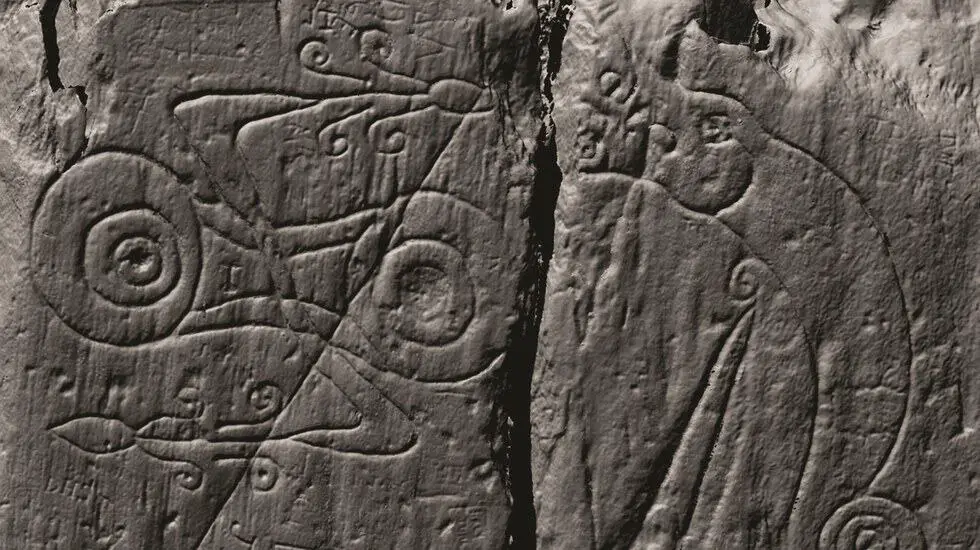 The researchers found that 65 percent of the signs stayed in use over the course of thousands of years. Some signs appeared to be locally used without wide distribution, while some were used across the world, all the way to Indonesia and Australia. They seem to have agreed-upon culturally-recognized meanings.
The geometric shapes aren’t like a written representation of a spoken language but are stylized abstract representations of things people saw in the world around them.
 These early representations may be the first inspirations for what later developed into abstracted written language. She thinks of them as similar to emojis today.? ?
Now that the researchers have found the common symbols, they are working translate what they mean. Objects like a 16,000-year-old necklace from a burial site in France may serve as a helpful decoder. In this case, the necklace is covered with 45 different signs. (see below)  You can find out more in the book “The First Signs: Unlocking the Mysteries of the World’s Oldest Symbols,” by Genevieve von Petzinger. It’s fascinating to know that ancient geometric symbols appear around the world dating back 40,000 years, though some experts point out that ancient humans created symbolic markings as far back as 500,000 years ago.
See Genevieve von Petzinger discuss this topic in her TED Talk and National Geographic below: YouTube Video Here: https://www.youtube.com/watch?v=aSF4zk2nsTU Featured image: Screenshot via YouTube When quantum particles work together, they can produce signals far stronger than any one particle could generate alone. This collective phenomenon, called superradiance, is a powerful example of cooperation at the quantum level. Until now, superradiance was mostly known for making quantum systems lose their energy too quickly, posing challenges for quantum technologies.
Formed as a result of the natural processes that created quarries and other natural phenomena millions of years ago underground, the city of Paris and its catacombs are famed for many reasons. Probably one of the most macabre is that it contains about 150 miles of quarries under its streets, complete with the bones of over six million people buried in them. Lauded as one of the most infamous tourist sites in the country, the catacombs are a complex maze that has a rich, if not dark, history. What began as a new promise of wealth and big city life resulted in massive overcrowding in the 1700s. This overcrowding naturally led to disease and death, and Paris’ cemeteries weren’t big enough to contain all of the bodies that resulted. With the city’s cemeteries full to the brink and the smell of rotting bodies killing the local economy, along with morale and trade, the city closed the Les Innocents Cemetery in 1780; said to be the biggest at the time in France.  According to one report:
After closing the quarries due to multiple instances of the Parisian streets collapsing as a result of the massive digging that was mostly unregulated, they were dedicated on April 7, 1786, as a consecrated site for a final resting place for the overcrowded cemeteries, also closed. Between 1787 and 1814, Parisians worked day and night to carry the bones from the closed cemeteries to the quarries, called an ossuary. It was opened to the public even before the transfer was complete in 1809. Ultimately, the last bones from other cemeteries, in addition to Saint-Eustache and Saint Etienne-de-Grès, were finally placed into the catacombs by 1814, and others the final bones placed about 1860. Sadly, because the work was dangerous and quite horrible, only poorer Parisians would accept the work. According to a report, they could only move older, decomposed bodies and any skeleton that they unearthed that still contained human flesh had to be burned to the bone. Additionally, some parts of Les Innocents were “left untouched because some mass graves were too recent for their bodies to be exhumed.” Because the initial deposit of bones was haphazard, simply thrown into piles, Inspector Héricart De Thury ordered that workers rearrange them, an order that ultimately resulted in today’s arrangement.
Tourists can visit the catacombs to this day but are restricted only to specific areas that cover about a mile of the tunnels because visiting the other areas was rendered illegal since 1955. This was largely because many people have gotten lost and, as a result, died in the tunnels, not to mention the very hazardous nature of the underground structures. One story in particular notes that three teens had to be rescued because they got lost for three days. Another is a bit creepier, as a few cataphiles (what illegal catacomb explorers are called) found a camcorder of an unnamed man who apparently got lost as well. Said to be a seasoned cataphile, he allegedly got disoriented, panicked and dropped the camera, only to run off in the darkness. He was allegedly never seen again. The recovered footage was aired in a documentary in the 2000s (view it below).
Over the years, many people have gotten lost and were never seen again. Also, over the years, many people have gotten lost and made it out alive. You can find many such videos of their adventures on YouTube. Recently, improvements were made to the catacombs, and it was eventually turned over to the Carnavalet Museum – History of Paris in 2002. The museum still controls and takes care of the catacombs today. If you wish to visit the catacombs, you can get more information on the site and on what you’ll need to do to prepare to enter the ossuary. This includes purchasing a ticket. But if you do visit, remember that while being one of the most beautiful sites, it is also a sacred site, and you should venture underground accordingly. View the documentary of the lost footage here: Featured Image: Screenshot via YouTube Video Astronomers from the Aryabhatta Research Institute of Observational Sciences (ARIES) in India and elsewhere have conducted a long-term photometric and spectroscopic study of a young stellar object known as V1180 Cassiopeiae. Results of the study, published December 23 on the arXiv preprint server, unveil the dual nature of this object.
Researchers working on China’s fully superconducting Experimental Advanced Superconducting Tokamak (EAST) have experimentally accessed a theorized “density-free regime” for fusion plasmas, achieving stable operation at densities well beyond conventional limits.
Dark matter is an elusive type of matter that does not emit, absorb or reflect light, interacting very weakly with ordinary matter. These characteristics make it impossible to detect using conventional technologies used by physicists to study matter particles.
Hypervelocity stars have, since the 1920s, been an important tool that allows astronomers to study the properties of the Milky Way galaxy, such as its gravitational potential and the distribution of matter. Now astronomers from China have made a large-volume search for hypervelocity stars by utilizing a special class of stars known for their distinct, regular, predictable pulsation behavior that makes them useful as distance indicators.
Class B; November 2025; California, San Bernardino County
Experimental particle physicists working at the MicroBooNE experiment at Fermilab National Accelerator Laboratory have found evidence against the existence of a “sterile” type of neutrino hypothesized to be responsible for previous experiments’ anomalous results, as detailed in a paper published in Nature.
|
||
|
Copyright © 2026 Paranormal News Network - All Rights Reserved Powered by WordPress & Atahualpa 99 queries. 0.101 seconds. |
||
 ? ?
? ?
